
Fructose: A Friend in Fruit, a Foe in the Can… What's the Story?
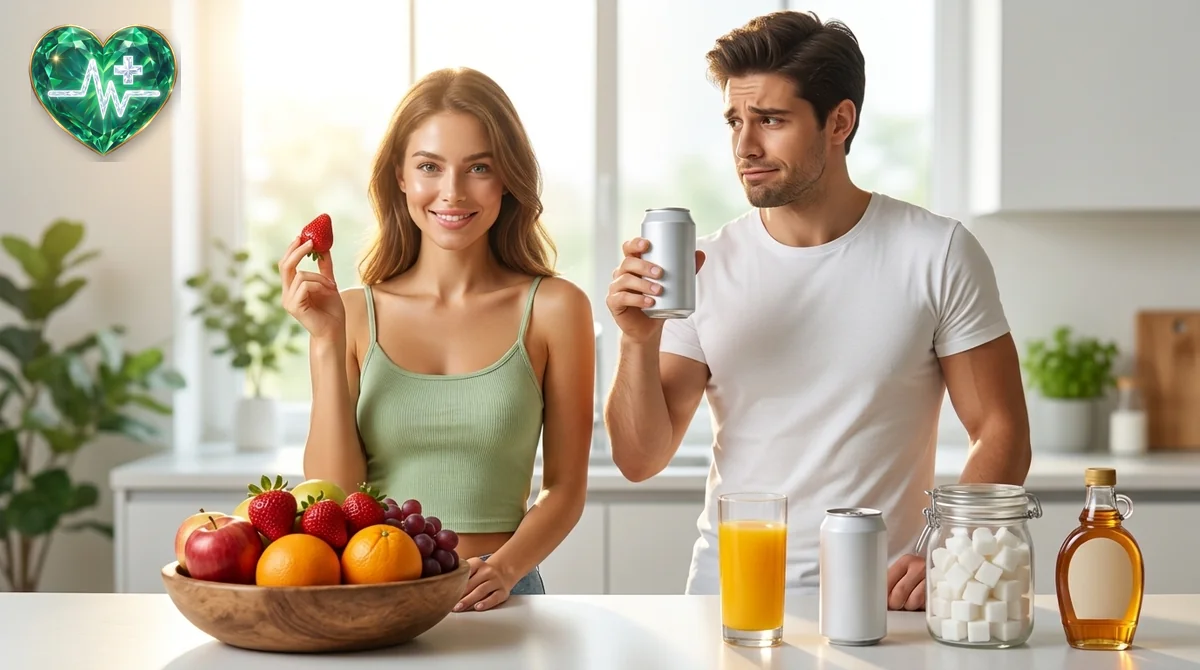
Believe it or not: an apple, a glass of apple juice and a can of soft drink. All three contain fructose. But your body handles each of them in a completely different way… so much so that one of them is your friend, and the other may be your hidden enemy.
Let's understand the story from the beginning, without complications, and without denying ourselves everything sweet 😄
What does "added sugar" mean?
When we talk about added sugar, we don't mean the sugar that occurs naturally inside an apple or in milk. We mean the sugar that has been added to food, or that is drunk on its own:
- White sugar (sucrose): the one in your sugar bowl. Every grain of it is a glucose molecule holding hands with a fructose molecule. So it is half glucose and half fructose.
- High-fructose corn syrup (HFCS): very common in America; in Europe you find it on labels as glucose-fructose syrup (in Dutch glucose-fructosestroop). The type used in drinks contains about 55% fructose.
- Juice: even natural 100% juice with no added sugar. The World Health Organization counts its sugar as "free sugars", exactly like added sugar. Why? We'll find out in a moment.
And sugar loves to hide behind "innocent" names: dextrose, maltose, glucose syrup, rice syrup, maltodextrin, invert sugar… and in the end they are all sugar. So if you find three of these names on the same pack, you know the product is full of sugar, just spread over several names so it doesn't come first in the ingredients 😏
Where is the danger? In the amount and the speed
A spoon of sugar in your tea does nothing. The problem is that the spoon of sugar in your tea doesn't stay just one: tea in the morning, coffee at noon, a can of soft drink with lunch, a piece of cake in the evening…
Let me give you a shocking number: a can of regular soft drink (330 ml) contains about 35 g of sugar, which is about 9 teaspoons. The World Health Organization recommends keeping free sugars below 10% of your daily calories, and ideally below 5%, which is about 25 g (6 teaspoons) for the whole day. So one can uses up your allowance for a day and a half!
And liquid sugar is the most dangerous, for two reasons:
- It is drunk fast: a whole can in two minutes, so all the sugar arrives at once.
- It doesn't fill you up: your body doesn't count calories from drinks the way it counts calories from food, so you eat your normal meal on top of it.
The heart of the story: glucose and fructose… brothers, but each on its own road
They reach the gut together, but from there each takes its own road:
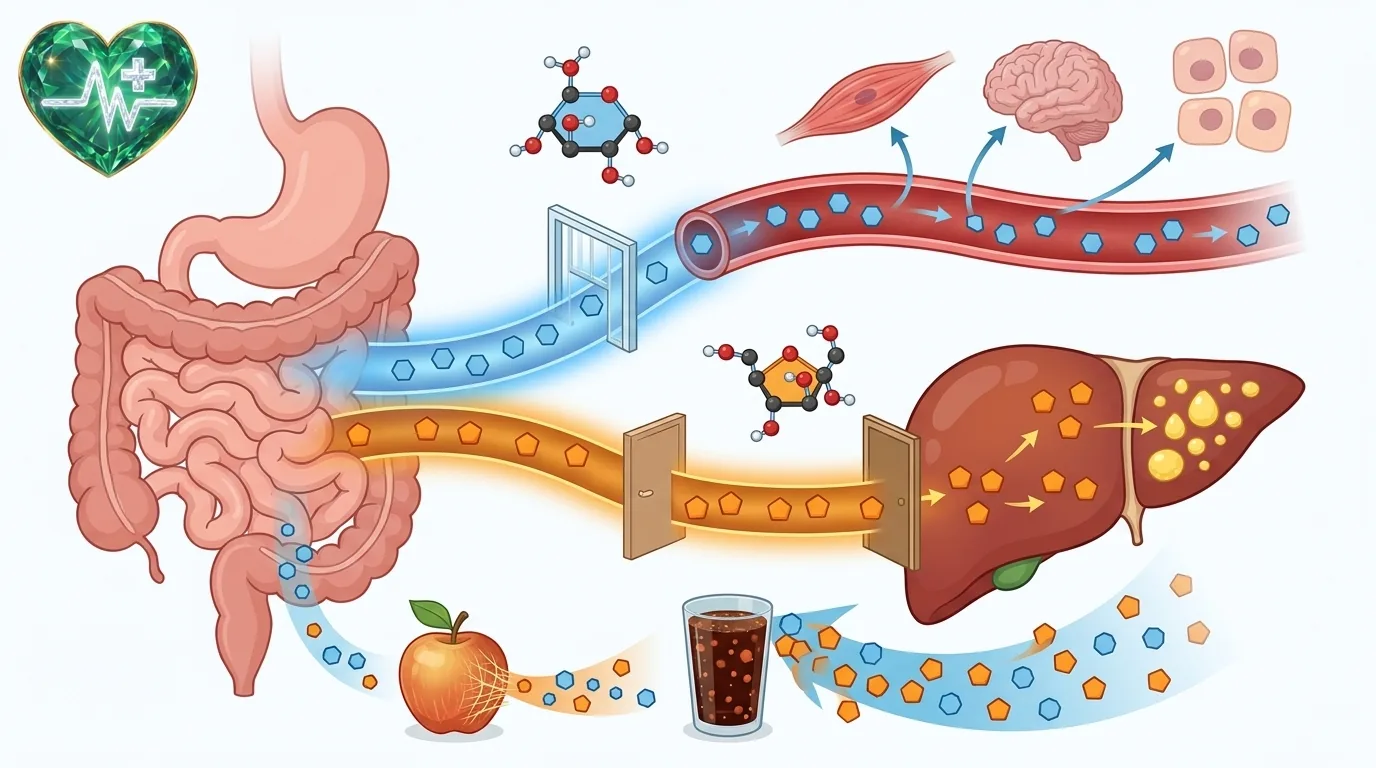
Glucose is the body's "official fuel". It enters the blood, and every cell in your body knows how to use it: the muscles, the brain and the heart. When it rises in the blood, the pancreas releases insulin, and insulin opens the doors of the cells so it can get in.
Fructose has a different story. Almost only the liver knows how to handle it. So it travels from the gut straight to the liver, through the portal vein. And that's where the story begins.
Let me tell you the story another way 🍽️
Imagine your liver is a restaurant, and the sugar is customers coming in to eat.
Most of the glucose goes to "other restaurants" in the body anyway: the muscles, the brain and the heart. Whatever comes to our restaurant enters through the main door, which has a doorman (an enzyme called PFK, but let's just call him good old Bob 😄). Good old Bob looks around the restaurant: if there are free tables, he lets the customer in. If the restaurant is full, he tells them "wait outside for a bit".
Fructose is coming to our restaurant in particular, and it doesn't come in through the main door. It comes in through the kitchen door, and there there is no doorman! And the owner of the restaurant (the liver) can't turn anyone away; he has to take in every customer who walks in.
- If there are only a few customers, the owner finds them free tables, and everything is fine. That means the liver turns the fructose into glucose, or stores it as a quick reserve (glycogen).
- But if the restaurant is already full, meaning the glucose that came with the fructose has filled the stores and raised insulin, there isn't a single free chair, and the customers keep coming in one after another through the kitchen door. So what does the owner do? He lines them up in the corners and the corridors… piled on top of each other 😅 And that is exactly what happens: the liver turns the excess fructose into fat, and this process has a scientific name: de novo lipogenesis.
And here's the real problem: customers piled up in the corners don't leave easily. That means the fat made in the liver stays piled up inside it, and that is how fatty liver begins (its new scientific name is MASLD). Some of them the owner sends out through the back door onto the street, meaning they go out into the blood as triglycerides. And all of this goes hand in hand with insulin resistance, which we talked about in the blood pressure article.
Is there evidence for this?
Definitely. In a well-known study published in 2009, people with excess weight drank sweetened drinks that made up a quarter of their daily calories, for 10 weeks. One group drank drinks sweetened with fructose, and another with glucose. The surprise: both gained about the same weight, but only the fructose group gained fat around the organs in the belly (visceral fat), saw the fats in their blood go up, and became less sensitive to insulin.
So the same calories, but not the same harm.
Wait… fructose doesn't raise blood sugar?!
Yes, and here is a big trap. The glycemic index of fructose is only about 15, while glucose is 100 and white sugar about 65. Why? Because fructose doesn't go into the blood much; it goes to the liver. So the blood sugar meter doesn't see it.
That's why some products full of fructose, such as agave syrup, are marketed as "low glycemic index", as if they were healthy. But a low index here doesn't mean the product is innocent; it means the whole load is going to the liver instead of the blood.
The lesson: the glycemic index is a useful tool, but not everything with a low index is healthy. (And we saw the same thing with luqaimat, whose index is low because of the fat!)
OK… and fruit? Doesn't it contain fructose too?
It does, and this is the question that scares so many people that they have stopped eating fruit. But let me reassure you: whole fruit is your friend, and the reason comes down to 4 words: amount, speed, fibre and water.
1. The amount is small. A medium apple contains about 11 g of fructose. A can of soft drink contains roughly 17 to 19 g, with nothing useful alongside it.
2. The gut protects the liver. In experiments on mice in 2018, scientists found that the small intestine itself processes small amounts of fructose and turns them into glucose before they reach the liver. But when a large amount comes all at once, the gut can't keep up, so the fructose spills over into the liver. The researchers think the same thing likely happens in humans.
3. Fibre slows things down. The fibre in an apple works like a net and lets the sugar out slowly.
4. Water fills you up. Try eating 4 apples one after another. Hard, right? But you can drink the sugar of those 4 apples in a glass of apple juice in a minute!
And here the restaurant comparison comes back: an apple is like a single customer strolling in through the kitchen door, and the owner easily finds him a table. A soft drink, though, is a whole tour bus unloading all at once at the kitchen door 🚌 and the restaurant is already full… so guess where he'll put them? In the corners, piled on top of each other!
And what do the big studies say? In a huge study that followed more than 180,000 people for many years, those who ate more whole fruit (especially blueberries, grapes and apples) had a lower risk of type 2 diabetes. But those who drank more juice had a higher risk.
So the same fruit, but the form changes everything. That's why the World Health Organization counts the sugar in juice like added sugar.
OK, so what are the alternatives?
If you want sweetness without the load on your liver, there are plenty of options. But each one has its own story:
🌿 Stevia
From the leaves of a plant from South America, and about 200 to 300 times sweeter than sugar. No calories, and it doesn't raise blood sugar. Two drops in a cup of coffee are enough. Its only drawback is a light bitter taste if you use more.
In Europe: permitted, with the code E960.
🧊 Erythritol
From the family of "sugar alcohols", with about 70% of the sweetness of sugar. Its glycemic index is zero, and its calories are almost zero. The secret is that the body absorbs it but doesn't burn it, and passes it out unchanged in the urine. So it goes through the body just passing through like a tourist: it looks around and goes back home 😄
But watch out for two things:
- The European Food Safety Authority (EFSA) reviewed it in 2023 and set a daily limit: half a gram per kilo of your body weight (about 35 g for a person weighing 70 kilos). The main reason is that large amounts cause diarrhoea.
- An observational study in 2023 found that people with high levels of erythritol in their blood had a higher risk of heart problems. But note: the body makes erythritol itself, and the study doesn't prove that the sweetener is the cause. So the subject is still being researched, and we advise moderation, as with anything else.
💧 Sucralose
Made from sugar itself after a chemical modification, and about 600 times sweeter. No calories, and it doesn't raise blood sugar, and heat doesn't spoil it, so it works for cooking and baking. And honestly? I personally use two drops of it in my coffee every day ☕
In Europe: permitted, with the code E955.
🌲 Xylitol
Another sugar alcohol, with a sweetness close to sugar, and a glycemic index of about 13. Well known in chewing gum because it doesn't harm the teeth. But large amounts of it also cause diarrhoea.
And a very important fact: xylitol is toxic to dogs 🐶 even a small amount can be dangerous for them. So if you have a dog, keep xylitol gum away from it!
🍈 Monk fruit and allulose
Two you hear about a lot in American videos. But in Europe their legal status is different:
- Allulose: still not permitted in the European Union. The European authority (EFSA) said in 2025 that the dossier did not contain enough safety studies.
- Monk fruit: its status in Europe is limited and complicated, so you won't find it as easily as stevia.
So if you live in Europe, stevia, erythritol and sucralose are the practical options.
And in all fairness: in 2023 the World Health Organization said it does not recommend non-sugar sweeteners as a way to lose weight, because studies have not shown a clear long-term benefit. So these sweeteners are a tool for cutting down on sugar, not a diet prescription. The real goal is for your tongue to get used, little by little, to less sweetness 😉
"Natural alternatives"… that are sugar in the end 🍯
Here we need to be honest, because a lot of products are sold as "healthy":
| Alternative | Glycemic index | The truth |
|---|---|---|
| Honey | about 61 | A natural sugar, about half of it fructose |
| Coconut sugar | about 54 | Sugar, with the same calories as white sugar |
| Date syrup | not available | Concentrated sugar from dates |
| White sugar | about 65 | For comparison |
Coconut Sugar Fenugreek Tea with Honey
Honey contains a few useful compounds, but the body handles it as sugar. And coconut sugar often says "low glycemic index" on the pack, but the University of Sydney measured it at about 54, right on the edge of low, and not very far from white sugar.
The bottom line? "Natural" sugar… naturally still raises your sugar 😄 The amount is what makes the difference, not the name on the pack.
How to cut down on sugar without feeling deprived
Nobody wants to live without sweet things, and there's no need to. Here are practical steps you can start tomorrow:
- Start with drinks. If you drink soft drinks or juice every day, this is the biggest win. You can swap them for sparkling water with lemon, unsweetened iced tea, or iced hibiscus. Hibiscus Iced Tea
- Eat your fruit, don't drink it. An apple instead of a glass of apple juice.
- Cut the spoons gradually. If you put two spoons in your tea, make it one and a half for two weeks, then one. Your tongue gets used to it faster than you think.
- Read the label. Look for "of which sugars" in the nutrition table, and for the hidden names we talked about. And if you don't have time to read every pack in the supermarket, leave it to us 👇
- Use sweeteners smartly. Two drops of stevia or sucralose in coffee and tea, and erythritol for baking, but all in moderation.
- Have something sweet after a meal, not on its own. A sweet after a meal with protein and fibre is gentler on blood sugar than one on an empty stomach. Dutch Apple Pie (Appeltaart)
- Choose your breakfast well. Large rolled oats with fruit, instead of sweetened breakfast cereal. Gluten-Free Rolled Oats
The bottom line in two sentences
The fructose in fruit comes in a small amount, together with fibre and water, and the gut keeps up with it, so it is your friend. The fructose in drinks and added sugar, though, comes in a large amount all at once, so it spills over into the liver, and there it turns into fat. So don't be afraid of the apple… be afraid of the can! 🍎🥤
Sources ▾
- World Health Organization. Guideline: Sugars intake for adults and children. Geneva: WHO; 2015.
- Tappy L, Lê KA. Metabolic effects of fructose and the worldwide increase in obesity. Physiol Rev. 2010;90(1):23–46.
- Stanhope KL et al. Consuming fructose-sweetened, not glucose-sweetened, beverages increases visceral adiposity and lipids and decreases insulin sensitivity in overweight/obese humans. J Clin Invest. 2009;119(5):1322–34.
- Jang C et al. The small intestine converts dietary fructose into glucose and organic acids. Cell Metab. 2018;27(2):351–61.
- Muraki I et al. Fruit consumption and risk of type 2 diabetes: results from three prospective longitudinal cohort studies. BMJ. 2013;347:f5001.
- Atkinson FS, Foster-Powell K, Brand-Miller JC. International tables of glycemic index and glycemic load values: 2008. Diabetes Care. 2008;31(12):2281–3.
- Livesey G. Health potential of polyols as sugar replacers, with emphasis on low glycaemic properties. Nutr Res Rev. 2003;16(2):163–91.
- EFSA Panel on Food Additives and Flavourings. Re-evaluation of erythritol (E 968) as a food additive. EFSA J. 2023;21(12):e8430.
- Witkowski M et al. The artificial sweetener erythritol and cardiovascular event risk. Nat Med. 2023;29(3):710–8.
- EFSA Panel on Nutrition, Novel Foods and Food Allergens (NDA). Safety of D-allulose as a novel food pursuant to Regulation (EU) 2015/2283. EFSA J. 2025;23(6):e9468.
- Rinella ME et al. A multisociety Delphi consensus statement on new fatty liver disease nomenclature. J Hepatol. 2023;79(6):1542–56.
- World Health Organization. Use of non-sugar sweeteners: WHO guideline. Geneva: WHO; 2023.
Awareness note: this article is for general awareness about nutrition and lifestyle and does not replace advice from your doctor.
Medically reviewed by Dr. Wassim Habib | Founder, WiBo Health · 31 October 2026