
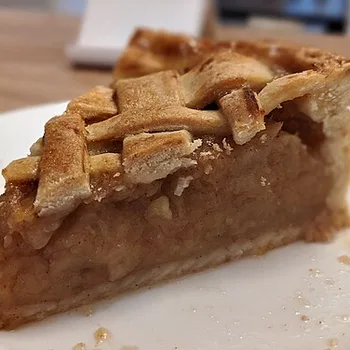
Dutch Apple Pie (Appeltaart)
Quick answer
A medium portion of Dutch Apple Pie (Appeltaart) (100 g) contains 285 kcal, with 42.2 g of net carbohydrates and 3.2 g of protein. Its glycemic index is 41 (Low) for how fast it raises blood sugar, while its glycemic load per portion is 17.3 (Medium) for its actual effect.
- Carbs45 g62.7%
- Protein3.2 g4.5%
- Fat10.5 g32.9%
- Fibre2.8 g
Percentages of total energy (calories)
How many calories are in apple pie?
Appeltaart is the pride of Dutch cafés, and no visit to the Netherlands is complete without a slice with cream! There are 285 calories per 100 g, and a slice (about 100 g) has about the same, with about 10 g of fat. And if you put whipped cream on top, add even more.
Does apple pie raise blood sugar?
Here is a small surprise: baked apple pie was measured in an Australian study, and its glycemic index came out at 41, which means low. The reason is that apples themselves have a low index (36), and the fat in the pastry slows digestion.
But as with luqaimat, a low index is not the whole story. The glycemic load of a slice is about 17, which means medium, and the calories are high. Its insulin index is 47, which means it stimulates insulin moderately.
How to eat it smartly
- One slice with a cup of coffee is enough.
- Order it without cream, or with just a small spoonful.
- You can eat it after a meal, not as a meal on its own.
- At home, you can cut the sugar in the recipe by a third and add more apple and cinnamon. The taste stays sweet.
Lighter alternatives
- Instead of a slice of appeltaart with cream: a slice without cream, or half a slice.
- Instead of the whole pie: an oven-baked apple with cinnamon and a spoon of Greek yoghurt.
Nutrition facts
| Nutrient | Per 100 g | Per typical portion (100 g) |
|---|---|---|
| Calories | 285 kcal | 285 kcal |
| Protein | 3.2 g | 3.2 g |
| Carbohydrate | 45 g | 45 g |
| Available carbohydrate | 42.2 g | 42.2 g |
| Sugar | not available | — |
| Fat | 10.5 g | 10.5 g |
| Dietary fibre | 2.8 g | 2.8 g |
| Glycemic index | 41 · Low | |
| Glycemic load | — | 17.3 |
| Insulin index | 47 | |
The typical portion is approximate, for comparison purposes.
Comparison & smarter alternatives
Among the foods in Sweets & desserts with a glycemic index (56), it ranks 2 (lowest first).
Frequently asked questions
How many calories are in a slice of appeltaart?
285 calories per 100 g, and a slice (about 100 g) has about the same, without the cream.
Does apple pie raise blood sugar?
Its index is low (41), but the load of a slice is medium (about 17), and the calories are high.
Is apple pie suitable for weight loss?
As a treat, in a small slice without cream, not every day.
Why is the index of apple pie low?
Because apples themselves have a low index (36), and the fat in the pastry slows digestion.
Read also
- HbA1c & Insulin Resistance: Comprehensive Clinical GuideArticle
- Prediabetes: How to Stop the Train and Lower Your HbA1cGuide
- Gestational Diabetes Guide: Normal Levels and Foods to EatGuide
References & Scientific Sources
- The glycemic index of this food is a clinically reviewed estimate by the WiBo Health medical team, not a laboratory measurement from the International GI Tables (Atkinson 2021). GI bands (low ≤ 55 · medium 56–69 · high ≥ 70) follow: ISO 26642:2010. Food products — Determination of the glycaemic index (GI) and recommendation for food classification. International Organization for Standardization; 2010. www.iso.org/standard/43633.html
- The glycemic index (41) and the insulin index (47) are taken from a measurement of baked apple pie (the closest measured food to Dutch appeltaart); they are not a direct laboratory measurement of this food. Bao J, Atkinson F, Petocz P, Willett WC, Brand-Miller JC. Prediction of postprandial glycemia and insulinemia in lean, young, healthy adults: glycemic load compared with carbohydrate content alone. Am J Clin Nutr. 2011;93(5):984–96.
- Definition of available carbohydrate and glycemic load: FAO/WHO. Carbohydrates in human nutrition: report of a joint FAO/WHO expert consultation. FAO Food and Nutrition Paper 66. Rome; 1998. www.fao.org/4/w8079e/w8079e00.htm
Medically reviewed by Dr. Wassim Habib | Founder, WiBo Health · 31 October 2026
Disclaimer: This guidance is for nutritional lifestyle orientation and does not constitute a diagnostic medical device under EU Regulation MDR 2017/745.