
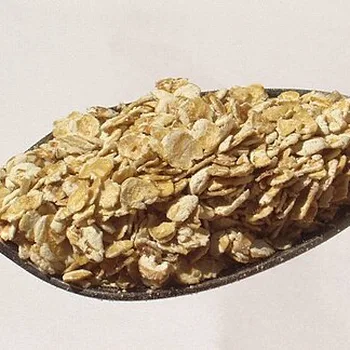
Gluten-Free Rolled Oats
Quick answer
A medium portion of Gluten-Free Rolled Oats (40 g) contains 148 kcal, with 20.8 g of net carbohydrates and 5.2 g of protein. Its glycemic index is 55 (Low) for how fast it raises blood sugar, while its glycemic load per portion is 11.4 (Medium) for its actual effect.
- Carbs24.8 g68.3%
- Protein5.2 g14.3%
- Fat2.8 g17.4%
- Fibre4 g
Percentages of total energy (calories)
How many calories are in oats?
Oats have become the king of breakfast, and nothing beats a hot bowl at the start of the day. There are 370 calories in 100 grams of dry oats, and the usual portion (40 g, about half a cup) has 148 calories, with 5 g of protein and 4 g of fibre. So a medium bowl keeps you full until lunch.
Do oats raise blood sugar?
Oats make us proud here 😄 Rolled oats have a glycemic index of 55, which means low, and a glycemic load per portion of about 11, which means medium. The secret is the soluble fibre called beta-glucan: it acts like a gel in the stomach and slows the entry of sugar into the blood.
But watch out, not all oats are the same. Instant oats have an index of 79, which is high, because they are ground and pre-cooked, so they are digested much faster.
What does "gluten-free" mean?
Oats are naturally gluten-free, but they are often milled in the same mills as wheat, so they get contaminated with it. "Gluten-free" oats are grown and milled away from wheat, which matters for people with coeliac disease. The grain itself is the same, so the calories and the index are the same.
Do oats make you gain weight?
Oats on their own do not make you gain weight; on the contrary, the fibre fills you up. What makes you gain weight is the toppings: honey, sugar, chocolate and peanut butter in large amounts.
How to eat oats smartly
- You can choose large flakes or steel-cut oats instead of instant.
- You can cook them in milk or top them with Greek yoghurt or nuts. Protein and healthy fats calm blood sugar even more.
- You can get sweetness from strawberries or berries instead of honey and sugar.
- The best time to eat them? Breakfast or after exercise, but any time works.
Lighter alternatives
- Instead of instant oats (79): large rolled oats (55).
- Instead of sweetened breakfast cereal: a bowl of oats with fruit; it is more filling and gentler on blood sugar.
- If you want fewer carbohydrates: half a portion of oats with a spoon of chia seeds and Greek yoghurt.
Nutrition facts
| Nutrient | Per 100 g | Per typical portion (40 g) |
|---|---|---|
| Calories | 370 kcal | 148 kcal |
| Protein | 13 g | 5.2 g |
| Carbohydrate | 62 g | 24.8 g |
| Available carbohydrate | 52 g | 20.8 g |
| Sugar | about 1 g | — |
| Fat | 7 g | 2.8 g |
| Dietary fibre | 10 g | 4 g |
| Glycemic index | 55 · Low | |
| Glycemic load | — | 11.4 |
| Insulin index | not tested | |
The typical portion is approximate, for comparison purposes.
Comparison & smarter alternatives
Among the foods in Grains & starches with a glycemic index (62), it ranks 42 (lowest first).
Frequently asked questions
How many calories are in oats?
370 calories per 100 g dry, and 148 calories in the usual portion (40 g).
Do oats raise blood sugar?
Rolled oats have an index of 55 (low) and a load per portion of about 11 (medium). Instant oats (79), however, raise blood sugar faster.
Are oats suitable for weight loss and dieting?
Definitely. The fibre in them keeps you full for longer, but the amount and the toppings are what make the difference.
Are gluten-free oats better than ordinary oats?
In terms of calories and sugar they are the same. The difference only matters for people with a gluten sensitivity or coeliac disease.
Read also
- HbA1c & Insulin Resistance: Comprehensive Clinical GuideArticle
- Prediabetes: How to Stop the Train and Lower Your HbA1cGuide
- Gestational Diabetes Guide: Normal Levels and Foods to EatGuide
References & Scientific Sources
- The glycemic index of this food is a clinically reviewed estimate by the WiBo Health medical team, not a laboratory measurement from the International GI Tables (Atkinson 2021). GI bands (low ≤ 55 · medium 56–69 · high ≥ 70) follow: ISO 26642:2010. Food products — Determination of the glycaemic index (GI) and recommendation for food classification. International Organization for Standardization; 2010. www.iso.org/standard/43633.html
- The glycemic index of this food is taken from ordinary rolled oat porridge (55 ± 2), because being gluten-free does not change the type of grain; it is not a direct laboratory measurement of the gluten-free product. Atkinson FS, Foster-Powell K, Brand-Miller JC. International tables of glycemic index and glycemic load values: 2008. Diabetes Care 2008;31(12):2281–3.
- Sugar value: USDA FoodData Central.
- Definition of available carbohydrate and glycemic load: FAO/WHO. Carbohydrates in human nutrition: report of a joint FAO/WHO expert consultation. FAO Food and Nutrition Paper 66. Rome; 1998. www.fao.org/4/w8079e/w8079e00.htm
Medically reviewed by Dr. Wassim Habib | Founder, WiBo Health · 31 October 2026
Disclaimer: This guidance is for nutritional lifestyle orientation and does not constitute a diagnostic medical device under EU Regulation MDR 2017/745.