
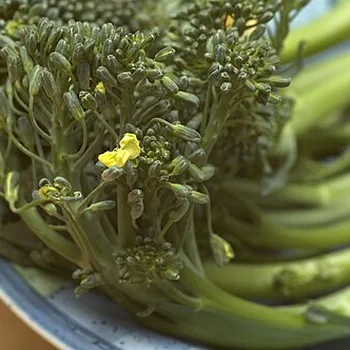
Tenderstem Broccolini (Bimi)
Quick answer
A medium portion of Tenderstem Broccolini (Bimi) (100 g) contains 35 kcal, with 2 g of net carbohydrates and 3 g of protein.
- Carbs5.2 g57.1%
- Protein3 g33%
- Fat0.4 g9.9%
- Fibre3.2 g
Percentages of total energy (calories)
Broccolini, sold as bimi, is a vegetable developed in Japan by crossing broccoli with Chinese kale (gai lan). It has long, thin, tender stems and small florets, so you eat it all from floret to stem end without waste, with a mildly sweet taste and none of the toughness of ordinary broccoli stalks. It is an excellent diet choice, giving 3g of plant protein per 100g for only 35 kcal, and contains vitamin K and calcium, which contribute to the maintenance of normal bones.
💡 Smart Nutritional Guidance
Consumption advice
Suits low-carb, keto and plant-based diets; eat 100 to 150g alongside your protein for a satisfying meal.
Best preparation methods
No peeling needed: stir-fry it in a hot pan for just 3 minutes with a little sesame or olive oil, sliced garlic and toasted almonds to keep its crunch.
Important Nutritional Note
Broccolini is rich in vitamin K, so people taking warfarin should keep their intake steady from week to week, without sudden changes, in agreement with their doctor.
Nutrition facts
| Nutrient | Per 100 g | Per typical portion (100 g) |
|---|---|---|
| Calories | 35 kcal | 35 kcal |
| Protein | 3 g | 3 g |
| Carbohydrate | 5.2 g | 5.2 g |
| Available carbohydrate | 2 g | 2 g |
| Fat | 0.4 g | 0.4 g |
| Dietary fibre | 3.2 g | 3.2 g |
The typical portion is approximate, for comparison purposes.
Comparison & smarter alternatives
It has 35 kcal per 100 g, ranking 45 of 73 in Vegetables (lowest first).
Related foods from the same family:
Frequently asked questions
Is Tenderstem Broccolini (Bimi) good for weight loss?
Yes. Tenderstem Broccolini (Bimi) is very low in calories (35 kcal per 100 g), so you can eat a generous amount to add volume and fullness to a meal without many calories.
How does Tenderstem Broccolini (Bimi) affect blood sugar?
Tenderstem Broccolini (Bimi) contains only 2 g of available carbohydrate per 100 g, so the glycemic index does not apply and its direct effect on blood sugar is minimal. The meal’s effect depends on what you eat with it, such as bread, rice or sweetened sauces.
What is the nutritional value of a typical portion of Tenderstem Broccolini (Bimi)?
A typical 100 g portion of Tenderstem Broccolini (Bimi) provides about 35 kcal, 3 g protein, 5.2 g carbohydrate, 0.4 g fat and 3.2 g fibre.
Is broccolini better for weight loss than ordinary broccoli?
Their nutritional value is similar and both are low in calories, but broccolini is quicker to prepare and eaten whole without discarding the stalk, which makes it more enjoyable on a diet.
Does broccolini affect blood sugar?
Its effect on blood sugar is very small (the glycemic index does not apply): it is a non-starchy vegetable that helps keep glucose steady when eaten with meals.
Can broccolini be eaten raw in a salad?
Yes. Its stems are tender and crunchy like green asparagus, and eating it raw preserves the heat-sensitive vitamin C.
Read also
References & Scientific Sources
- The glycemic index does not apply because this food has less than 5 g of available carbohydrate per 100 g, and a GI test requires 25 to 50 g of available carbohydrate, per: ISO 26642:2010. Food products — Determination of the glycaemic index (GI) and recommendation for food classification. International Organization for Standardization; 2010. www.iso.org/standard/43633.html
- Definition of available carbohydrate and glycemic load: FAO/WHO. Carbohydrates in human nutrition: report of a joint FAO/WHO expert consultation. FAO Food and Nutrition Paper 66. Rome; 1998. www.fao.org/4/w8079e/w8079e00.htm
Reviewed by the WiBo Health medical team · Last reviewed 13 October 2026
Disclaimer: This guidance is for nutritional lifestyle orientation and does not constitute a diagnostic medical device under EU Regulation MDR 2017/745.