
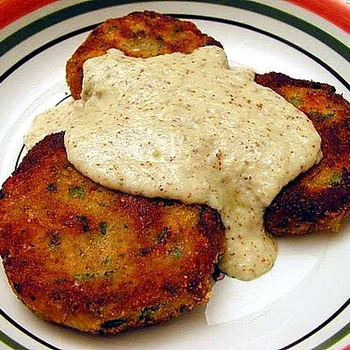
Kamaboko Fish Cake
Quick answer
A medium portion of Kamaboko Fish Cake (60 g) contains 59 kcal, with 5.1 g of net carbohydrates and 7.5 g of protein. Its glycemic index is 45 (Low) for how fast it raises blood sugar, while its glycemic load per portion is 2.3 (Low) for its actual effect.
- Carbs5.1 g35.9%
- Protein7.5 g52.7%
- Fat0.7 g11.4%
- Fibre0 g
Percentages of total energy (calories)
Steamed Japanese fish cake, known as kamaboko, with its famous pink-swirled form narutomaki, is a long-standing seafood staple in Japanese cuisine. It is made from boned and skinned white fish paste (surimi), lightly seasoned, shaped on wooden boards and steamed without frying. It provides 12.5g of protein per 100g with hardly any fat (1.2g) and few calories (98 kcal), which makes it a light way to add protein to your dishes.
💡 Smart Nutritional Guidance
Consumption advice
A 60g portion (4 to 5 slices) gives you about 7.5g of protein for only 59 kcal: a good snack for children or a way to boost the nutritional value of soups and noodles.
Best preparation methods
Kamaboko is pre-cooked and ready to eat: cut it into thin half-centimetre slices and lay them on hot noodle soup, or add it to a cold salad with cucumber and a sprinkle of sesame.
Important Nutritional Note
Some commercial brands use wheat starch, egg white or shellfish extracts as binders, and may contain mirin (rice wine) and a fair amount of salt. Read the label carefully if you have a wheat, egg or shellfish allergy, or if you are looking for a halal or low-sodium product.
Nutrition facts
| Nutrient | Per 100 g | Per typical portion (60 g) |
|---|---|---|
| Calories | 98 kcal | 58.8 kcal |
| Protein | 12.5 g | 7.5 g |
| Carbohydrate | 8.5 g | 5.1 g |
| Available carbohydrate | 8.5 g | 5.1 g |
| Fat | 1.2 g | 0.7 g |
| Dietary fibre | 0 g | 0 g |
The typical portion is approximate, for comparison purposes.
Comparison & smarter alternatives
Among the foods in Asian dishes with a glycemic index (33), it ranks 15 (lowest first).
Smart alternatives from the same family:
Frequently asked questions
Is Kamaboko Fish Cake good for weight loss?
It can be a useful part of a weight-loss plan because it provides 12.8 g of protein per 100 kcal, and protein supports fullness. A 60 g portion gives 59 kcal.
How does Kamaboko Fish Cake affect blood sugar?
Its glycemic index is 45 (Low), a clinically reviewed estimate rather than a laboratory measurement. A typical 60 g portion has a glycemic load of 2.3 (Low), so the effect of this portion on blood sugar is limited.
What is the nutritional value of a typical portion of Kamaboko Fish Cake?
A typical 60 g portion of Kamaboko Fish Cake provides about 59 kcal, 7.5 g protein, 5.1 g carbohydrate, 0.7 g fat and 0 g fibre.
Is kamaboko fish cake suitable for weight loss?
Yes. Its energy density is low (98 kcal per 100g) and it contains almost no fat, so it adds satisfying seafood protein to your dishes without many calories.
Does kamaboko contain added sugar, and does it affect blood sugar?
Traditional recipes use a little starch and sugar or mirin to improve the texture, but its glycemic index is low (45) and the glycemic load of a 60g portion is only about 2.3, so it does not cause sudden rises in blood sugar.
Is kamaboko a healthy substitute for fresh fish?
It provides light seafood protein, but it does not contain the omega-3 found in oily fish such as salmon and sardines. Treat it as a varied addition alongside whole fish, not a replacement.
Read also
- Prediabetes: How to Stop the Train and Lower Your HbA1cGuide
- Gestational Diabetes Guide: Normal Levels and Foods to EatGuide
References & Scientific Sources
- The glycemic index of this food is a clinically reviewed estimate by the WiBo Health medical team, not a laboratory measurement from the International GI Tables (Atkinson 2021). GI bands (low ≤ 55 · medium 56–69 · high ≥ 70) follow: ISO 26642:2010. Food products — Determination of the glycaemic index (GI) and recommendation for food classification. International Organization for Standardization; 2010. www.iso.org/standard/43633.html
- Definition of available carbohydrate and glycemic load: FAO/WHO. Carbohydrates in human nutrition: report of a joint FAO/WHO expert consultation. FAO Food and Nutrition Paper 66. Rome; 1998. www.fao.org/4/w8079e/w8079e00.htm
Reviewed by the WiBo Health medical team · Last reviewed 13 October 2026
Disclaimer: This guidance is for nutritional lifestyle orientation and does not constitute a diagnostic medical device under EU Regulation MDR 2017/745.