
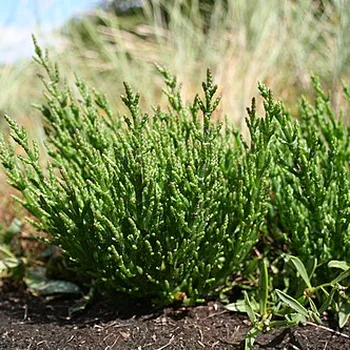
Sea Samphire (Zeekraal)
Quick answer
A medium portion of Sea Samphire (Zeekraal) (50 g) contains 14 kcal, with 0.9 g of net carbohydrates and 0.9 g of protein.
- Carbs2.1 g62.9%
- Protein0.9 g27%
- Fat0.1 g10.1%
- Fibre1.2 g
Percentages of total energy (calories)
Samphire, or sea beans (zeekraal in Dutch), is a wild coastal plant that grows in tidal salt marshes, including along the coast of the Dutch province of Zeeland. Its fleshy green shoots burst in the mouth with a juicy crunch and a natural salty flavour. It contains magnesium, potassium, vitamin C and some iodine, with very few calories (28 kcal per 100g), and is used instead of salt to season dishes. It is itself high in sodium, though, so count it as a salt replacement rather than a free vegetable.
💡 Smart Nutritional Guidance
Consumption advice
A 40 to 50g portion is ideal; use it instead of salt to season salads, fish and seafood dishes.
Best preparation methods
Do not add any salt to the dish: sauté it in a hot pan for just 60 seconds with a spoonful of olive oil or a little butter and a pinch of black pepper, until warm but still crunchy.
Important Nutritional Note
Although its salts are natural, samphire is high in sodium, so people with high blood pressure or on the DASH diet should not overdo it and should count it as a salt substitute, not a free vegetable.
Nutrition facts
| Nutrient | Per 100 g | Per typical portion (50 g) |
|---|---|---|
| Calories | 28 kcal | 14 kcal |
| Protein | 1.8 g | 0.9 g |
| Carbohydrate | 4.2 g | 2.1 g |
| Available carbohydrate | 1.8 g | 0.9 g |
| Fat | 0.3 g | 0.1 g |
| Dietary fibre | 2.4 g | 1.2 g |
The typical portion is approximate, for comparison purposes.
Comparison & smarter alternatives
It has 28 kcal per 100 g, ranking 32 of 73 in Vegetables (lowest first).
Related foods from the same family:
Frequently asked questions
Is Sea Samphire (Zeekraal) good for weight loss?
Yes. Sea Samphire (Zeekraal) is very low in calories (28 kcal per 100 g), so you can eat a generous amount to add volume and fullness to a meal without many calories.
How does Sea Samphire (Zeekraal) affect blood sugar?
Sea Samphire (Zeekraal) contains only 1.8 g of available carbohydrate per 100 g, so the glycemic index does not apply and its direct effect on blood sugar is minimal. The meal’s effect depends on what you eat with it, such as bread, rice or sweetened sauces.
What is the nutritional value of a typical portion of Sea Samphire (Zeekraal)?
A typical 50 g portion of Sea Samphire (Zeekraal) provides about 14 kcal, 0.9 g protein, 2.1 g carbohydrate, 0.1 g fat and 1.2 g fibre.
Is samphire good for an underactive thyroid?
It contains a little iodine, which the thyroid needs to make its hormones, but it does not treat an underactive thyroid, and the most common cause (Hashimoto’s) does not improve with extra iodine. Follow your doctor’s treatment and do not rely on samphire as an iodine source.
Does samphire suit keto and low-carb diets?
Yes. Its net carbohydrate is very low, and it adds magnesium, potassium and sodium, electrolytes that people starting keto may need, while keeping an eye on salt if your blood pressure is high.
Does samphire affect blood sugar?
Its effect on blood sugar is very small (the glycemic index does not apply) because it contains so little sugar and starch.
Read also
References & Scientific Sources
- The glycemic index does not apply because this food has less than 5 g of available carbohydrate per 100 g, and a GI test requires 25 to 50 g of available carbohydrate, per: ISO 26642:2010. Food products — Determination of the glycaemic index (GI) and recommendation for food classification. International Organization for Standardization; 2010. www.iso.org/standard/43633.html
- Definition of available carbohydrate and glycemic load: FAO/WHO. Carbohydrates in human nutrition: report of a joint FAO/WHO expert consultation. FAO Food and Nutrition Paper 66. Rome; 1998. www.fao.org/4/w8079e/w8079e00.htm
Reviewed by the WiBo Health medical team · Last reviewed 13 October 2026
Disclaimer: This guidance is for nutritional lifestyle orientation and does not constitute a diagnostic medical device under EU Regulation MDR 2017/745.