
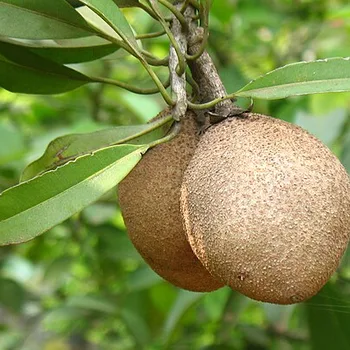
Sapodilla (Chikoo)
Quick answer
A medium portion of Sapodilla (Chikoo) (100 g) contains 83 kcal, with 14.7 g of net carbohydrates and 0.4 g of protein. Its glycemic index is 45 (Low) for how fast it raises blood sugar, while its glycemic load per portion is 6.6 (Low) for its actual effect.
- Carbs20 g87.4%
- Protein0.4 g1.7%
- Fat1.1 g10.8%
- Fibre5.3 g
Percentages of total energy (calories)
If you had to describe sapodilla in one phrase, it would be "caramel that grows on a tree"! It is a wonderful tropical fruit with a plain brown skin, but cut it open and you find cinnamon-coloured flesh with a soft, slightly grainy texture that melts in your mouth like a pear dipped in brown sugar and honey. The happy surprise if you watch your blood sugar: its natural sweetness comes wrapped in fibre (5.3 g per 100 g), so it reaches your blood more slowly than you might expect. Its estimated glycemic index is 45, in the low range, and a fruit has a glycemic load of 6.6 (low), giving you a royal sweet treat without the guilt.
💡 Smart Nutritional Guidance
Consumption advice
The golden portion is one medium fruit (about 100 g). Eat it as a dessert after a lunch with vegetables and protein, or as an afternoon snack that ends your craving for processed sweets.
Best preparation methods
Eat it fresh with a spoon; do not turn it into juice or a blended drink. For a restaurant-style touch, dice it and mix it with a pot of Greek yoghurt and a sprinkle of chopped walnuts: a balanced dessert that keeps sugar absorption calm.
Important Nutritional Note
In the centre are shiny black seeds with a small hook; remove them and do not swallow them. Make sure the fruit is fully ripe and soft, like a ripe avocado, because hard unripe fruit is rich in astringent tannins that leave your mouth feeling dry for a while.
Nutrition facts
| Nutrient | Per 100 g | Per typical portion (100 g) |
|---|---|---|
| Calories | 83 kcal | 83 kcal |
| Protein | 0.4 g | 0.4 g |
| Carbohydrate | 20 g | 20 g |
| Available carbohydrate | 14.7 g | 14.7 g |
| Fat | 1.1 g | 1.1 g |
| Dietary fibre | 5.3 g | 5.3 g |
The typical portion is approximate, for comparison purposes.
Comparison & smarter alternatives
Among the foods in Fruit with a glycemic index (57), it ranks 37 (lowest first).
Smart alternatives from the same family:
Frequently asked questions
Is Sapodilla (Chikoo) good for weight loss?
It can be included in moderation: it contains 5.3 g of fibre per 100 g, which supports fullness, and a 100 g portion gives 83 kcal.
How does Sapodilla (Chikoo) affect blood sugar?
Its glycemic index is 45 (Low), a clinically reviewed estimate rather than a laboratory measurement. A typical 100 g portion has a glycemic load of 6.6 (Low), so the effect of this portion on blood sugar is limited.
What is the nutritional value of a typical portion of Sapodilla (Chikoo)?
A typical 100 g portion of Sapodilla (Chikoo) provides about 83 kcal, 0.4 g protein, 20 g carbohydrate, 1.1 g fat and 5.3 g fibre.
Does its intense sweetness make it risky with insulin resistance?
The sweetness is deceptive! It is very sweet, but its sugar comes with about 5.3 g of fibre per fruit, so if you eat one whole fruit after a meal, your blood sugar rises gradually and calmly.
How can I tell a ripe sapodilla from an unripe one that makes my throat feel rough?
Press it gently with your thumb: if it gives like a ripe peach or avocado and the skin is smooth and brown with no green streaks, it is at its sweetest.
Does sapodilla help with constipation and a sluggish gut?
Yes. Its generous fibre adds bulk to stools and helps keep bowel movements regular, especially if you drink enough water during the day.
Read also
- Prediabetes: How to Stop the Train and Lower Your HbA1cGuide
- Gestational Diabetes Guide: Normal Levels and Foods to EatGuide
References & Scientific Sources
- The glycemic index of this food is a clinically reviewed estimate by the WiBo Health medical team, not a laboratory measurement from the International GI Tables (Atkinson 2021). GI bands (low ≤ 55 · medium 56–69 · high ≥ 70) follow: ISO 26642:2010. Food products — Determination of the glycaemic index (GI) and recommendation for food classification. International Organization for Standardization; 2010. www.iso.org/standard/43633.html
- Definition of available carbohydrate and glycemic load: FAO/WHO. Carbohydrates in human nutrition: report of a joint FAO/WHO expert consultation. FAO Food and Nutrition Paper 66. Rome; 1998. www.fao.org/4/w8079e/w8079e00.htm
Reviewed by Dr. Wassim Habib · Last reviewed 20 October 2026
Disclaimer: This guidance is for nutritional lifestyle orientation and does not constitute a diagnostic medical device under EU Regulation MDR 2017/745.