
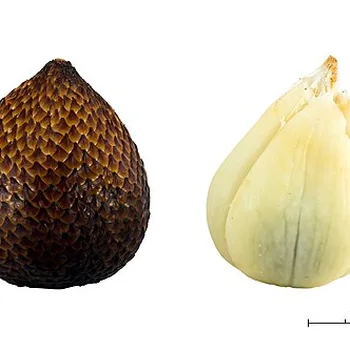
Salak (Snake Fruit)
Quick answer
A medium portion of Salak (Snake Fruit) (100 g) contains 82 kcal, with 18 g of net carbohydrates and 0.8 g of protein. Its glycemic index is 45 (Low) for how fast it raises blood sugar, while its glycemic load per portion is 8.1 (Low) for its actual effect.
- Carbs21 g92.5%
- Protein0.8 g3.5%
- Fat0.4 g4%
- Fibre3 g
Percentages of total energy (calories)
A charming tropical fruit from Indonesia and Malaysia, with brown, tightly packed scales that look exactly like snakeskin, which makes many people hesitate to touch it! But press the tip and peel it easily, and you reveal ivory-white segments as crunchy as a fresh apple, with a unique flavour that blends pineapple sweetness, a soft banana note and a light tang. Its estimated glycemic index is low (45), the glycemic load of a portion is 8.1 (low), and its dense texture needs good chewing, which leaves you pleasantly full.
💡 Smart Nutritional Guidance
Consumption advice
Two medium peeled fruits (about 100 g) make a satisfying snack between meals.
Best preparation methods
Under the scaly skin you will find a thin, transparent membrane around the white segments; leave it on, as it is part of the natural fibre. The large brown seed in the middle of each segment is not edible.
Important Nutritional Note
Salak contains natural astringent compounds, so enjoy one or two fruits in moderation and avoid eating large amounts (more than 4 fruits) at once, because overdoing it can temporarily slow your bowels.
Nutrition facts
| Nutrient | Per 100 g | Per typical portion (100 g) |
|---|---|---|
| Calories | 82 kcal | 82 kcal |
| Protein | 0.8 g | 0.8 g |
| Carbohydrate | 21 g | 21 g |
| Available carbohydrate | 18 g | 18 g |
| Fat | 0.4 g | 0.4 g |
| Dietary fibre | 3 g | 3 g |
The typical portion is approximate, for comparison purposes.
Comparison & smarter alternatives
Among the foods in Fruit with a glycemic index (57), it ranks 38 (lowest first).
Smart alternatives from the same family:
Frequently asked questions
Is Salak (Snake Fruit) good for weight loss?
It can be included in moderation: it contains 3 g of fibre per 100 g, which supports fullness, and a 100 g portion gives 82 kcal.
How does Salak (Snake Fruit) affect blood sugar?
Its glycemic index is 45 (Low), a clinically reviewed estimate rather than a laboratory measurement. A typical 100 g portion has a glycemic load of 8.1 (Low), so the effect of this portion on blood sugar is limited.
What is the nutritional value of a typical portion of Salak (Snake Fruit)?
A typical 100 g portion of Salak (Snake Fruit) provides about 82 kcal, 0.8 g protein, 21 g carbohydrate, 0.4 g fat and 3 g fibre.
Why do I feel full so quickly after eating salak?
Because its flesh is dense and crunchy and needs longer chewing, and it brings natural fibre. The longer you chew and digest, the sooner fullness signals reach your brain, before you eat more than you need.
Are the large salak seeds edible?
No, the seeds are brown, rock-hard and not edible. Discard them and eat only the crunchy fleshy segments.
Is salak suitable for type 2 diabetes?
Yes, in its set portion (one to two fruits), since its glycemic load is low. Asian laboratory studies found its extracts rich in antioxidants, but no proven benefit for people has been shown yet, so see it as a tasty fruit within a balanced diet.
Read also
- Prediabetes: How to Stop the Train and Lower Your HbA1cGuide
- Gestational Diabetes Guide: Normal Levels and Foods to EatGuide
References & Scientific Sources
- The glycemic index of this food is a clinically reviewed estimate by the WiBo Health medical team, not a laboratory measurement from the International GI Tables (Atkinson 2021). GI bands (low ≤ 55 · medium 56–69 · high ≥ 70) follow: ISO 26642:2010. Food products — Determination of the glycaemic index (GI) and recommendation for food classification. International Organization for Standardization; 2010. www.iso.org/standard/43633.html
- Definition of available carbohydrate and glycemic load: FAO/WHO. Carbohydrates in human nutrition: report of a joint FAO/WHO expert consultation. FAO Food and Nutrition Paper 66. Rome; 1998. www.fao.org/4/w8079e/w8079e00.htm
Reviewed by Dr. Wassim Habib · Last reviewed 20 October 2026
Disclaimer: This guidance is for nutritional lifestyle orientation and does not constitute a diagnostic medical device under EU Regulation MDR 2017/745.