
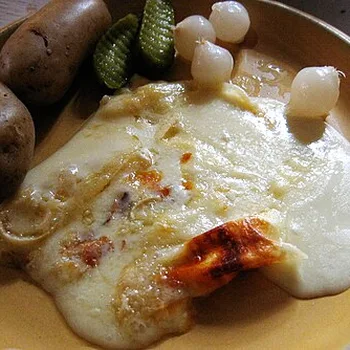
Swiss Raclette Cheese
Quick answer
A medium portion of Swiss Raclette Cheese (100 g) contains 355 kcal, with 0.5 g of net carbohydrates and 24 g of protein.
- Carbs0.5 g0.6%
- Protein24 g27.4%
- Fat28 g72%
- Fibre0 g
Percentages of total energy (calories)
Not just a piece of cheese, but a cheerful Swiss winter tradition that brings loved ones together! The word "raclette" comes from the French for "to scrape": the cheese is heated until it melts and browns at the edges, then scraped over vegetables. It is soft and milky with a warm aroma, and a meal portion (100 g) gives you about 24 g of protein that fills you up quickly. It contains almost no carbohydrate, so the glycemic index does not apply.
💡 Smart Nutritional Guidance
Consumption advice
A full winter meal portion is about 100 g, melted in 3 or 4 rounds with vegetables.
Best preparation methods
It is traditionally served over boiled potatoes, but if you have diabetes or are dieting, melt it over steamed broccoli and cauliflower florets with mushrooms and small gherkins (cornichons): the same pleasure with far fewer carbohydrates.
Important Nutritional Note
It is a rich meal, high in salt and saturated fat: eat it slowly with plenty of vegetables and keep it for special occasions rather than every day, especially if you watch your blood pressure or cholesterol. It is traditionally made with animal rennet, so choose microbial rennet if you are looking for halal.
Nutrition facts
| Nutrient | Per 100 g | Per typical portion (100 g) |
|---|---|---|
| Calories | 355 kcal | 355 kcal |
| Protein | 24 g | 24 g |
| Carbohydrate | 0.5 g | 0.5 g |
| Available carbohydrate | 0.5 g | 0.5 g |
| Fat | 28 g | 28 g |
| Dietary fibre | 0 g | 0 g |
The typical portion is approximate, for comparison purposes.
Comparison & smarter alternatives
It provides 6.8 g of protein per 100 kcal, ranking 26 of 46 in Dairy & cheese (highest first).
Related foods from the same family:
Frequently asked questions
Is Swiss Raclette Cheese good for weight loss?
It can fit a balanced plan with portion control: a 100 g portion gives 355 kcal, and what matters most is your total daily intake and the rest of the meal.
How does Swiss Raclette Cheese affect blood sugar?
Swiss Raclette Cheese contains only 0.5 g of available carbohydrate per 100 g, so the glycemic index does not apply and its direct effect on blood sugar is minimal. The meal’s effect depends on what you eat with it, such as bread, rice or sweetened sauces.
What is the nutritional value of a typical portion of Swiss Raclette Cheese?
A typical 100 g portion of Swiss Raclette Cheese provides about 355 kcal, 24 g protein, 0.5 g carbohydrate, 28 g fat and 0 g fibre.
Does eating raclette raise cholesterol if you have insulin resistance?
Raclette does not raise blood sugar because it is almost carbohydrate-free, but it is rich in saturated fat, which can raise "bad" cholesterol if eaten often. So enjoy it on occasion, in the set portion, with vegetables instead of bread and potatoes.
Why does raclette melt so smoothly without the fat separating?
Because its balance of moisture and fat and its casein protein network let it melt at moderate heat into a smooth, even layer, which is exactly what it was made for.
Is a raclette meal suitable for active children and teenagers?
Yes, in a moderate portion: it is rich in protein and calcium, which matter for growing bones and muscles, served with vegetables and fruit for a balanced meal.
Read also
References & Scientific Sources
- The glycemic index does not apply because this food has less than 5 g of available carbohydrate per 100 g, and a GI test requires 25 to 50 g of available carbohydrate, per: ISO 26642:2010. Food products — Determination of the glycaemic index (GI) and recommendation for food classification. International Organization for Standardization; 2010. www.iso.org/standard/43633.html
- Definition of available carbohydrate and glycemic load: FAO/WHO. Carbohydrates in human nutrition: report of a joint FAO/WHO expert consultation. FAO Food and Nutrition Paper 66. Rome; 1998. www.fao.org/4/w8079e/w8079e00.htm
Reviewed by Dr. Wassim Habib · Last reviewed 20 October 2026
Disclaimer: This guidance is for nutritional lifestyle orientation and does not constitute a diagnostic medical device under EU Regulation MDR 2017/745.