
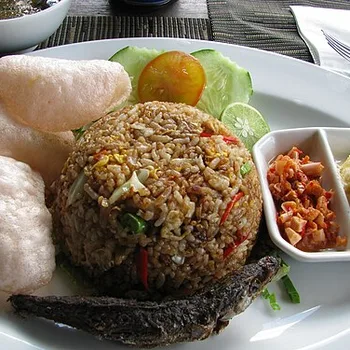
Nasi Goreng (Indonesian Fried Rice)
Quick answer
A medium portion of Nasi Goreng (Indonesian Fried Rice) (250 g) contains 438 kcal, with 65.5 g of net carbohydrates and 13.8 g of protein. Its glycemic index is 72 (High) for how fast it raises blood sugar, while its glycemic load per portion is 47.2 (High) for its actual effect.
- Carbs70 g63.2%
- Protein13.8 g12.4%
- Fat12 g24.4%
- Fibre4.5 g
Percentages of total energy (calories)
How many calories are in nasi goreng?
Nasi goreng is one of the best-known street foods in the Netherlands, coming from Indonesia and Suriname. There are 175 calories per 100 g, and a medium plate (250 g) has about 438 calories, with about 14 g of protein and 12 g of fat.
Does nasi goreng raise blood sugar?
Here we have to be honest: white rice is the base of the plate, and its glycemic index is high (about 73). The sweet ketjap sauce adds a little sugar on top, so the calculated index for the plate came out at about 72, which means high.
And more importantly, the glycemic load of a medium plate is about 47, which is very high, because the amount is large. So a full plate causes a clear spike in blood sugar.
How to eat it smartly
- You can split the plate in two: half rice and half stir-fried vegetables; the load becomes much lighter.
- Add egg and chicken: protein slows the entry of sugar into the blood.
- Use less sweet ketjap sauce, and use ordinary soy sauce with a little chilli.
- Rice cooked the day before and then fried is often gentler on blood sugar than fresh rice, because resistant starch forms in it.
Lighter alternatives
- Instead of white rice (73): brown rice (68), or half rice and half riced cauliflower.
- Instead of a large plate: a small plate with a cucumber salad.
Nutrition facts
| Nutrient | Per 100 g | Per typical portion (250 g) |
|---|---|---|
| Calories | 175 kcal | 437.5 kcal |
| Protein | 5.5 g | 13.8 g |
| Carbohydrate | 28 g | 70 g |
| Available carbohydrate | 26.2 g | 65.5 g |
| Sugar | not available | — |
| Fat | 4.8 g | 12 g |
| Dietary fibre | 1.8 g | 4.5 g |
| Glycemic index | 72 · High | |
| Glycemic load | — | 47.2 |
| Insulin index | not tested | |
The typical portion is approximate, for comparison purposes.
Comparison & smarter alternatives
Among the foods in Asian dishes with a glycemic index (34), it ranks 34 (lowest first).
Frequently asked questions
How many calories are in a plate of nasi goreng?
175 calories per 100 g, and a medium plate (250 g) has about 438 calories.
Does nasi goreng raise blood sugar?
Yes, its calculated index is about 72 (high), and the load of a plate is about 47, because its base is white rice.
Is nasi goreng suitable for weight loss?
It can be, but as a small plate with lots of vegetables and protein, and with less sauce.
What is the difference between nasi goreng and Chinese fried rice?
The idea is the same, but nasi goreng uses sweet ketjap sauce, so it often contains more sugar.
Read also
- HbA1c & Insulin Resistance: Comprehensive Clinical GuideArticle
- Prediabetes: How to Stop the Train and Lower Your HbA1cGuide
References & Scientific Sources
- The glycemic index of this food is a clinically reviewed estimate by the WiBo Health medical team, not a laboratory measurement from the International GI Tables (Atkinson 2021). GI bands (low ≤ 55 · medium 56–69 · high ≥ 70) follow: ISO 26642:2010. Food products — Determination of the glycaemic index (GI) and recommendation for food classification. International Organization for Standardization; 2010. www.iso.org/standard/43633.html
- The glycemic index of this food is calculated with the FAO/WHO formula for mixed meals (the mean of the ingredients' GI values, weighted by each ingredient's share of the available carbohydrate): boiled white rice (73 ± 4, Atkinson 2008) provides most of the carbohydrate, and the sugar in the ketjap sauce (sucrose, about 65) the rest. It is not a direct laboratory measurement. FAO/WHO. Carbohydrates in human nutrition. FAO Food and Nutrition Paper 66. Rome; 1998.
- Definition of available carbohydrate and glycemic load: FAO/WHO. Carbohydrates in human nutrition: report of a joint FAO/WHO expert consultation. FAO Food and Nutrition Paper 66. Rome; 1998. www.fao.org/4/w8079e/w8079e00.htm
Medically reviewed by Dr. Wassim Habib | Founder, WiBo Health · 31 October 2026
Disclaimer: This guidance is for nutritional lifestyle orientation and does not constitute a diagnostic medical device under EU Regulation MDR 2017/745.