
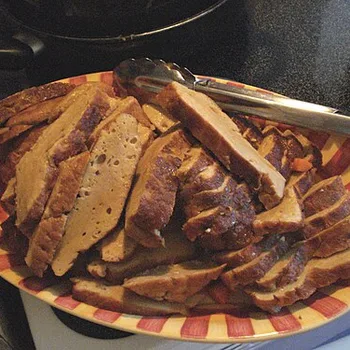
Marinated Grilled Seitan
Quick answer
A medium portion of Marinated Grilled Seitan (100 g) contains 165 kcal, with 4.7 g of net carbohydrates and 32 g of protein.
- Carbs5.5 g13.1%
- Protein32 g76.2%
- Fat2 g10.7%
- Fibre0.8 g
Percentages of total energy (calories)
In plant-based cooking seitan is known as “wheat meat”, one of the oldest meat alternatives, developed by vegetarian monks in East Asia centuries ago. Wheat flour is kneaded with water and the dough is rinsed repeatedly to wash out the starch until only an elastic network of wheat protein (gluten) remains. This gives it a fibrous texture that mimics sliced grilled meat or chicken, with 32g of protein per 100g and very little fat (about 2g), which makes it a favourite with athletes who want to build muscle while staying lean.
💡 Smart Nutritional Guidance
Consumption advice
A 100g portion covers more than half of an adult’s daily protein needs. Eat it with lysine-rich foods such as chickpeas, lentils and other legumes for a complete protein.
Best preparation methods
Seitan soaks up flavour easily: marinate it for two hours in crushed garlic, smoked paprika, olive oil and soy sauce, then grill it on a hot grill until the edges are browned and crisp.
Important Nutritional Note
Seitan is pure wheat gluten, so it is strictly off-limits for people with coeliac disease, wheat allergy or non-coeliac gluten sensitivity; in coeliac disease it damages the lining of the gut.
Nutrition facts
| Nutrient | Per 100 g | Per typical portion (100 g) |
|---|---|---|
| Calories | 165 kcal | 165 kcal |
| Protein | 32 g | 32 g |
| Carbohydrate | 5.5 g | 5.5 g |
| Available carbohydrate | 4.7 g | 4.7 g |
| Fat | 2 g | 2 g |
| Dietary fibre | 0.8 g | 0.8 g |
The typical portion is approximate, for comparison purposes.
Comparison & smarter alternatives
It has 165 kcal per 100 g, ranking 21 of 45 in Asian dishes (lowest first).
Related foods from the same family:
Frequently asked questions
Is Marinated Grilled Seitan good for weight loss?
It can be a useful part of a weight-loss plan because it provides 19.4 g of protein per 100 kcal, and protein supports fullness. A 100 g portion gives 165 kcal.
How does Marinated Grilled Seitan affect blood sugar?
Marinated Grilled Seitan contains only 4.7 g of available carbohydrate per 100 g, so the glycemic index does not apply and its direct effect on blood sugar is minimal. The meal’s effect depends on what you eat with it, such as bread, rice or sweetened sauces.
What is the nutritional value of a typical portion of Marinated Grilled Seitan?
A typical 100 g portion of Marinated Grilled Seitan provides about 165 kcal, 32 g protein, 5.5 g carbohydrate, 2 g fat and 0.8 g fibre.
Is seitan the same as tofu? What is the difference?
No. Tofu is made from soy milk and has a soft, smooth texture, while seitan is made from wheat gluten and has a fibrous, meat-like chew. Seitan also contains two to three times as much protein as tofu.
Is seitan suitable for diabetes and low-carb diets?
Yes, for people without wheat allergy or coeliac disease. Most of the starch is washed out during production, so it is low in carbohydrate (5.5g per 100g) and has little effect on blood sugar.
Can seitan cause indigestion or bloating?
People with a sensitive gut may feel heavy after eating it because of the dense gluten. Chew it well, cook it with aromatic spices such as ginger and cumin, and start with small portions.
Read also
References & Scientific Sources
- The glycemic index does not apply because this food has less than 5 g of available carbohydrate per 100 g, and a GI test requires 25 to 50 g of available carbohydrate, per: ISO 26642:2010. Food products — Determination of the glycaemic index (GI) and recommendation for food classification. International Organization for Standardization; 2010. www.iso.org/standard/43633.html
- Definition of available carbohydrate and glycemic load: FAO/WHO. Carbohydrates in human nutrition: report of a joint FAO/WHO expert consultation. FAO Food and Nutrition Paper 66. Rome; 1998. www.fao.org/4/w8079e/w8079e00.htm
Reviewed by the WiBo Health medical team · Last reviewed 13 October 2026
Disclaimer: This guidance is for nutritional lifestyle orientation and does not constitute a diagnostic medical device under EU Regulation MDR 2017/745.