
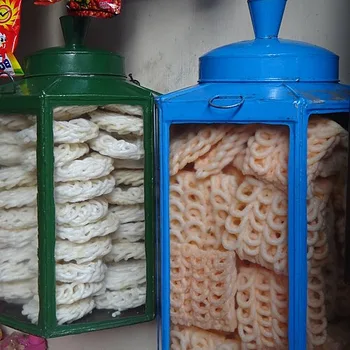
Prawn Crackers (Kroepoek)
Quick answer
A medium portion of Prawn Crackers (Kroepoek) (25 g) contains 121 kcal, with 16.7 g of net carbohydrates and 1.1 g of protein. Its glycemic index is 87 (High) for how fast it raises blood sugar, while its glycemic load per portion is 14.5 (Medium) for its actual effect.
- Carbs17 g56.8%
- Protein1.1 g3.8%
- Fat5.2 g39.5%
- Fibre0.3 g
Percentages of total energy (calories)
How many calories are in kroepoek?
Kroepoek are the white puffed crackers that come with every Indonesian plate in the Netherlands, with a light prawn flavour. So light that you feel you haven't eaten anything… and that is the trap 😅 There are 485 calories per 100 g! And a small bowl (about 25 g) has about 121 calories. A big bag disappears easily.
Does kroepoek raise blood sugar?
Yes, and fast. Kroepoek is based on starch (usually tapioca starch) puffed up by frying, and the closest food that has been measured is puffed rice crackers, with an index of about 87, which means very high.
The load of a small bowl is about 15, which means medium. But if you eat a whole bag, the number shoots up.
Why do they add up so fast?
Because the volume fools you: kroepoek is puffed and full of air, so 25 g looks like a big amount. But in the end it is starch and frying oil, with no fibre or protein to fill you up.
How to eat it smartly
- Put an amount in a small bowl, and don't eat straight from the bag.
- Make it an addition to the meal, not a snack in front of the TV.
- With Indonesian food, add more vegetables and protein instead of kroepoek.
Lighter alternatives
- Instead of a bag of kroepoek: a small handful with pickled cucumber (atjar).
- If you want a crunchy snack: roasted chickpeas, or cucumber and carrot sticks.
Nutrition facts
| Nutrient | Per 100 g | Per typical portion (25 g) |
|---|---|---|
| Calories | 485 kcal | 121.2 kcal |
| Protein | 4.5 g | 1.1 g |
| Carbohydrate | 68 g | 17 g |
| Available carbohydrate | 66.8 g | 16.7 g |
| Sugar | not available | — |
| Fat | 21 g | 5.2 g |
| Dietary fibre | 1.2 g | 0.3 g |
| Glycemic index | 87 · High | |
| Glycemic load | — | 14.5 |
| Insulin index | not tested | |
The typical portion is approximate, for comparison purposes.
Comparison & smarter alternatives
Among the foods in Asian dishes with a glycemic index (36), it ranks 36 (lowest first).
Frequently asked questions
How many calories are in kroepoek?
485 calories per 100 g, and a small bowl (25 g) has about 121 calories.
Does kroepoek raise blood sugar?
Yes, the closest measured food (puffed rice crackers) has an index of about 87, which means very high.
Is kroepoek suitable for weight loss?
Only in a very small amount. The volume fools you, and the calories add up fast.
What is kroepoek made of?
Usually tapioca starch with ground prawns, fried until it puffs up.
Read also
- HbA1c & Insulin Resistance: Comprehensive Clinical GuideArticle
- Prediabetes: How to Stop the Train and Lower Your HbA1cGuide
- Silent Fatty Liver (MASLD/NAFLD): Clinical GuideArticle
References & Scientific Sources
- This value is an estimate, not a direct laboratory measurement of this food. Details in the next item. GI bands (low ≤ 55 · medium 56–69 · high ≥ 70) follow: ISO 26642:2010. Food products — Determination of the glycaemic index (GI) and recommendation for food classification. International Organization for Standardization; 2010. www.iso.org/standard/43633.html
- The glycemic index of this food is taken from the closest food measured in a laboratory, puffed rice crisps and crackers (87 ± 2), because kroepoek is also a puffed starch cracker. It is not a direct laboratory measurement of kroepoek. Atkinson FS, Foster-Powell K, Brand-Miller JC. International tables of glycemic index and glycemic load values: 2008. Diabetes Care. 2008;31(12):2281–3.
- Definition of available carbohydrate and glycemic load: FAO/WHO. Carbohydrates in human nutrition: report of a joint FAO/WHO expert consultation. FAO Food and Nutrition Paper 66. Rome; 1998. www.fao.org/4/w8079e/w8079e00.htm
Medically reviewed by Dr. Wassim Habib | Founder, WiBo Health · 31 October 2026
Disclaimer: This guidance is for nutritional lifestyle orientation and does not constitute a diagnostic medical device under EU Regulation MDR 2017/745.