
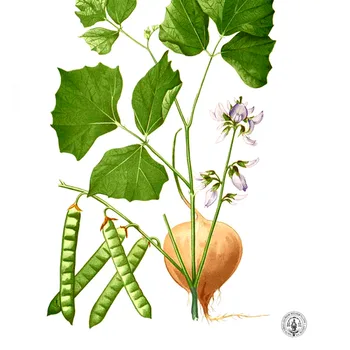
Fresh Jicama
Quick answer
A medium portion of Fresh Jicama (100 g) contains 38 kcal, with 3.9 g of net carbohydrates and 0.7 g of protein.
- Carbs8.8 g90.5%
- Protein0.7 g7.2%
- Fat0.1 g2.3%
- Fibre4.9 g
Percentages of total energy (calories)
Jicama (also called Mexican turnip or yam bean) is a great choice if you want the crunch of a vegetable with a watery sweetness like green apple. Under its thin brown skin is white flesh that is about 90% water, yet it provides 4.9g of fibre per 100g for only 38 kcal. A significant part of that fibre is inulin, a prebiotic that is not digested in the stomach but reaches the gut to feed beneficial bacteria such as bifidobacteria, making it a suitable snack for calorie-deficit, insulin-resistance and low-carb diets.
💡 Smart Nutritional Guidance
Consumption advice
You can easily eat 100 to 150g: it fills you up and quenches thirst, and it is an excellent alternative to chips when you crave something crunchy in the evening.
Best preparation methods
Peel and cut it into fries-shaped sticks, then squeeze over lime and sprinkle with chilli, paprika and a little salt, Mexican style, for a tangy, crunchy snack.
Important Nutritional Note
Only the peeled root of the jicama plant is eaten: the seeds, pods and leaves contain the toxic compound rotenone and must never be eaten.
Nutrition facts
| Nutrient | Per 100 g | Per typical portion (100 g) |
|---|---|---|
| Calories | 38 kcal | 38 kcal |
| Protein | 0.7 g | 0.7 g |
| Carbohydrate | 8.8 g | 8.8 g |
| Available carbohydrate | 3.9 g | 3.9 g |
| Fat | 0.1 g | 0.1 g |
| Dietary fibre | 4.9 g | 4.9 g |
The typical portion is approximate, for comparison purposes.
Comparison & smarter alternatives
It has 38 kcal per 100 g, ranking 1 of 8 in Potatoes & tubers (lowest first).
Related foods from the same family:
Frequently asked questions
Is Fresh Jicama good for weight loss?
Yes. Fresh Jicama is very low in calories (38 kcal per 100 g), so you can eat a generous amount to add volume and fullness to a meal without many calories.
How does Fresh Jicama affect blood sugar?
Fresh Jicama contains only 3.9 g of available carbohydrate per 100 g, so the glycemic index does not apply and its direct effect on blood sugar is minimal. The meal’s effect depends on what you eat with it, such as bread, rice or sweetened sauces.
What is the nutritional value of a typical portion of Fresh Jicama?
A typical 100 g portion of Fresh Jicama provides about 38 kcal, 0.7 g protein, 8.8 g carbohydrate, 0.1 g fat and 4.9 g fibre.
Is jicama allowed on keto and low-carb diets?
Yes. Although 100g contains 8.8g of carbohydrate, about 5g of it is fibre, leaving fewer than 4g of net carbs.
Does jicama raise blood sugar in people with diabetes?
Its effect on blood sugar is very small (the glycemic index does not apply because it has so little available carbohydrate). Inulin is not turned into glucose; it adds fullness and helps keep the glucose curve stable.
Does jicama cause gas?
Because it is rich in inulin, people who are not used to fibre may feel slightly bloated after large amounts. Start with a moderate 100g portion and let your gut adjust gradually.
Read also
- HbA1c & Insulin Resistance: Comprehensive Clinical GuideArticle
- Prediabetes: How to Stop the Train and Lower Your HbA1cGuide
References & Scientific Sources
- The glycemic index does not apply because this food has less than 5 g of available carbohydrate per 100 g, and a GI test requires 25 to 50 g of available carbohydrate, per: ISO 26642:2010. Food products — Determination of the glycaemic index (GI) and recommendation for food classification. International Organization for Standardization; 2010. www.iso.org/standard/43633.html
- Definition of available carbohydrate and glycemic load: FAO/WHO. Carbohydrates in human nutrition: report of a joint FAO/WHO expert consultation. FAO Food and Nutrition Paper 66. Rome; 1998. www.fao.org/4/w8079e/w8079e00.htm
Reviewed by the WiBo Health medical team · Last reviewed 13 October 2026
Disclaimer: This guidance is for nutritional lifestyle orientation and does not constitute a diagnostic medical device under EU Regulation MDR 2017/745.