
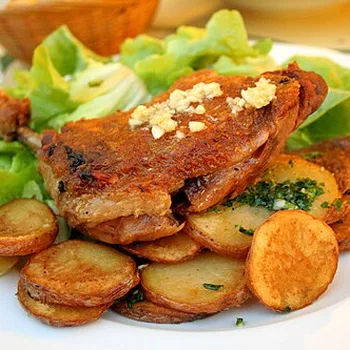
Duck Confit Leg (Confit de Canard)
Quick answer
A medium portion of Duck Confit Leg (Confit de Canard) (150 g) contains 420 kcal, with 0 g of net carbohydrates and 36 g of protein.
- Carbs0 g0%
- Protein36 g34.8%
- Fat30 g65.2%
- Fibre0 g
Percentages of total energy (calories)
Confit is one of the oldest French preserving methods: the duck leg is seasoned with salt and herbs, then cooked very gently for hours submerged in duck fat until the meat almost falls off the bone. When you crisp it in the oven, much of the excess fat runs off, leaving meat rich in protein, iron and B vitamins. Duck fat contains a good share of oleic acid, the same monounsaturated fatty acid found in olive oil, but it is still an animal fat with about one third saturated fat, so moderation matters. Confit contains no carbohydrate, so the glycemic index does not apply.
💡 Smart Nutritional Guidance
Consumption advice
An average leg (150 g, about 420 kcal and 36 g protein).
Best preparation methods
Put the leg on a rack over a tray in a hot oven (200 °C) for 15 to 20 minutes until the skin is crisp and the fat runs off, and serve with garlicky sautéed green beans or cauliflower mash.
Important Nutritional Note
Confit is salty by nature and rich in fat, so people with high blood pressure or high cholesterol should eat it in moderation and discard the melted fat in the tray rather than frying potatoes in it.
Nutrition facts
| Nutrient | Per 100 g | Per typical portion (150 g) |
|---|---|---|
| Calories | 280 kcal | 420 kcal |
| Protein | 24 g | 36 g |
| Carbohydrate | 0 g | 0 g |
| Available carbohydrate | 0 g | 0 g |
| Fat | 20 g | 30 g |
| Dietary fibre | 0 g | 0 g |
The typical portion is approximate, for comparison purposes.
Comparison & smarter alternatives
It provides 8.6 g of protein per 100 kcal, ranking 56 of 70 in Meat, fish & eggs (highest first).
Related foods from the same family:
Frequently asked questions
Is Duck Confit Leg (Confit de Canard) good for weight loss?
It can be a useful part of a weight-loss plan because it provides 8.6 g of protein per 100 kcal, and protein supports fullness. A 150 g portion gives 420 kcal.
How does Duck Confit Leg (Confit de Canard) affect blood sugar?
Duck Confit Leg (Confit de Canard) contains virtually no available carbohydrate, so the glycemic index does not apply and its direct effect on blood sugar is minimal. The meal’s effect depends on what you eat with it, such as bread, rice or sweetened sauces.
What is the nutritional value of a typical portion of Duck Confit Leg (Confit de Canard)?
A typical 150 g portion of Duck Confit Leg (Confit de Canard) provides about 420 kcal, 36 g protein, 0 g carbohydrate, 30 g fat and 0 g fibre.
Is duck fatty and bad for people with high cholesterol?
Duck fat has a good share of monounsaturated fat, but about one third is saturated. So people with high cholesterol are advised to heat the leg on an oven rack so the excess fat runs off, remove some of the skin, and not eat it often.
How do I serve duck confit on a low-carb diet?
Serve it with a plate of garlicky sautéed green beans, or with buttery cauliflower mash instead of mashed potatoes or potatoes fried in duck fat.
Does ready-made tinned French confit contain added sugar?
Traditional confit is just duck leg, duck fat and salt, with no sugar. Some products add flavourings or preservatives, though, so check the label, or scan it with the boodi app.
Read also
References & Scientific Sources
- The glycemic index does not apply because this food has less than 5 g of available carbohydrate per 100 g, and a GI test requires 25 to 50 g of available carbohydrate, per: ISO 26642:2010. Food products — Determination of the glycaemic index (GI) and recommendation for food classification. International Organization for Standardization; 2010. www.iso.org/standard/43633.html
- Definition of available carbohydrate and glycemic load: FAO/WHO. Carbohydrates in human nutrition: report of a joint FAO/WHO expert consultation. FAO Food and Nutrition Paper 66. Rome; 1998. www.fao.org/4/w8079e/w8079e00.htm
Reviewed by Dr. Wassim Habib · Last reviewed 21 October 2026
Disclaimer: This guidance is for nutritional lifestyle orientation and does not constitute a diagnostic medical device under EU Regulation MDR 2017/745.