
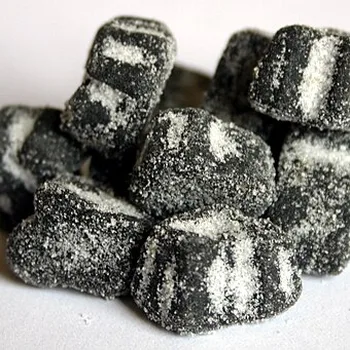
Salty Liquorice (Dubbel Zout Drop)
Quick answer
A medium portion of Salty Liquorice (Dubbel Zout Drop) (20 g) contains 62 kcal, with 13.7 g of net carbohydrates and 1.2 g of protein.
- Carbs14 g91.6%
- Protein1.2 g7.8%
- Fat0 g0.6%
- Fibre0.3 g
Percentages of total energy (calories)
How many calories are in drop?
Drop is the black sweet that you either love or hate, with nothing in between 😄 The Dutch eat large amounts of it. The "dubbel zout" (double salt) kind contains ammonium chloride (salmiak), which gives it its sharp salty taste. There are 310 calories per 100 g, and a small handful (20 g) has about 62 calories.
Does drop raise blood sugar?
Drop is based on sugar and starch or flour, and it is high in carbohydrate (70 g per 100 g). But there is no approved published measurement of its glycemic index, so we will not give you a number of our own. What is certain is that it is a sweet, and the body treats it like one.
The most important thing: liquorice and blood pressure ⚠️
This is something many people don't know: real liquorice contains a substance called glycyrrhizin, and large amounts of it can raise blood pressure and lower potassium. That is why, in Europe, sweets that contain liquorice must carry this text:
"Contains liquorice – people suffering from hypertension should avoid excessive consumption."
So if you have high blood pressure, keep drop to a very small amount, or skip it.
And the salt?
Salty drop contains ammonium chloride, not ordinary table salt, but moderation is still the key.
How to eat it smartly
- One or two pieces, not a whole bag.
- Don't eat it every day in large amounts, especially if you have high blood pressure.
- Read the package, and look for the liquorice warning.
Nutrition facts
| Nutrient | Per 100 g | Per typical portion (20 g) |
|---|---|---|
| Calories | 310 kcal | 62 kcal |
| Protein | 6 g | 1.2 g |
| Carbohydrate | 70 g | 14 g |
| Available carbohydrate | 68.5 g | 13.7 g |
| Sugar | not available | — |
| Fat | 0.2 g | 0 g |
| Dietary fibre | 1.5 g | 0.3 g |
| Glycemic index | Not available | |
| Glycemic load | Not available | |
| Insulin index | not tested | |
The typical portion is approximate, for comparison purposes.
Comparison & smarter alternatives
It has 310 kcal per 100 g, ranking 23 of 61 in Sweets & desserts (lowest first).
Frequently asked questions
How many calories are in drop?
310 calories per 100 g, and a small handful (20 g) has about 62 calories.
Does drop raise blood pressure?
Real liquorice in large amounts can raise blood pressure, which is why it carries a mandatory warning in Europe. If you have high blood pressure, keep it rare and small.
What does "dubbel zout" mean?
It means "double salt", because it contains a larger amount of ammonium chloride (salmiak).
Does drop raise blood sugar?
It is a sweet based on sugar and starch, so yes, but there is no approved published measurement of its index.
Read also
- HbA1c & Insulin Resistance: Comprehensive Clinical GuideArticle
- Prediabetes: How to Stop the Train and Lower Your HbA1cGuide
References & Scientific Sources
- There is no approved published measurement of the glycemic index of Dutch drop. The liquorice and blood pressure warning is the mandatory EU warning wording for confectionery containing glycyrrhizinic acid: Regulation (EU) No 1169/2011, Annex III.
- Definition of available carbohydrate and glycemic load: FAO/WHO. Carbohydrates in human nutrition: report of a joint FAO/WHO expert consultation. FAO Food and Nutrition Paper 66. Rome; 1998. www.fao.org/4/w8079e/w8079e00.htm
Medically reviewed by Dr. Wassim Habib | Founder, WiBo Health · 31 October 2026
Disclaimer: This guidance is for nutritional lifestyle orientation and does not constitute a diagnostic medical device under EU Regulation MDR 2017/745.