
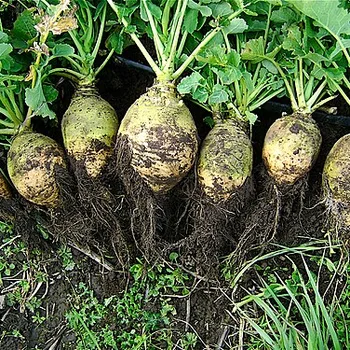
Cooked Rutabaga (Swede)
Quick answer
A medium portion of Cooked Rutabaga (Swede) (150 g) contains 56 kcal, with 9.4 g of net carbohydrates and 1.8 g of protein. Its glycemic index is 72 (High) for how fast it raises blood sugar, while its glycemic load per portion is 6.8 (Low) for its actual effect.
- Carbs12.9 g83.9%
- Protein1.8 g11.7%
- Fat0.3 g4.4%
- Fibre3.4 g
Percentages of total energy (calories)
Swede (koolraap in Dutch, rutabaga in American English) is a natural hybrid of cabbage and turnip and should not be confused with kohlrabi. Dieters in northern Europe love it for its yellow-orange flesh and sweet, earthy flavour that mimics potato once boiled and mashed, with only 37 kcal per 100g (less than half the calories of potato). Its glycemic index is high (about 72), but it contains so little carbohydrate that the glycemic load of a portion stays low (6.8), making it a safe and enjoyable swap in weight-loss and insulin-resistance diets.
💡 Smart Nutritional Guidance
Consumption advice
A 150g portion is filling for only about 56 kcal, an excellent choice when you want a warm dish that fills you up without upsetting your calorie plan.
Best preparation methods
Cut it into cubes and boil until soft, then mash with a pinch of nutmeg, black pepper and a teaspoon of butter for a velvety alternative to mashed potato.
Important Nutritional Note
Swede belongs to the cabbage family, which contains goitrogens. Cooking reduces these compounds, and normal food amounts are safe for the thyroid.
Nutrition facts
| Nutrient | Per 100 g | Per typical portion (150 g) |
|---|---|---|
| Calories | 37 kcal | 55.5 kcal |
| Protein | 1.2 g | 1.8 g |
| Carbohydrate | 8.6 g | 12.9 g |
| Available carbohydrate | 6.3 g | 9.4 g |
| Fat | 0.2 g | 0.3 g |
| Dietary fibre | 2.3 g | 3.4 g |
The typical portion is approximate, for comparison purposes.
Comparison & smarter alternatives
Among the foods in Vegetables with a glycemic index (21), it ranks 21 (lowest first).
Smart alternatives from the same family:
Frequently asked questions
Is Cooked Rutabaga (Swede) good for weight loss?
Yes. Cooked Rutabaga (Swede) is very low in calories (37 kcal per 100 g), so you can eat a generous amount to add volume and fullness to a meal without many calories.
How does Cooked Rutabaga (Swede) affect blood sugar?
Its glycemic index is 72 (High), a clinically reviewed estimate rather than a laboratory measurement. A typical 150 g portion has a glycemic load of 6.8 (Low), so the effect of this portion on blood sugar is limited.
What is the nutritional value of a typical portion of Cooked Rutabaga (Swede)?
A typical 150 g portion of Cooked Rutabaga (Swede) provides about 56 kcal, 1.8 g protein, 12.9 g carbohydrate, 0.3 g fat and 3.4 g fibre.
Is swede allowed on keto and low-carb diets?
Yes on moderate low-carb, and in measured portions on keto: it has about 6g of net carbohydrate per 100g, which makes it a good substitute for potatoes, which keto rules out.
Why is its glycemic index 72 yet it barely raises blood sugar?
The glycemic index measures how fast a fixed amount of carbohydrate (50g) is absorbed, whereas a normal 150g portion of swede contains only a little, so its glycemic load stays low (6.8) and does not disrupt blood sugar.
What is the difference between ordinary white turnip and yellow swede?
White turnip is smaller with a sharper taste and is often pickled, while swede is larger, with sweet golden-yellow flesh that suits cooking and mashing.
Read also
- HbA1c & Insulin Resistance: Comprehensive Clinical GuideArticle
- Prediabetes: How to Stop the Train and Lower Your HbA1cGuide
References & Scientific Sources
- The glycemic index of this food is a clinically reviewed estimate by the WiBo Health medical team, not a laboratory measurement from the International GI Tables (Atkinson 2021). GI bands (low ≤ 55 · medium 56–69 · high ≥ 70) follow: ISO 26642:2010. Food products — Determination of the glycaemic index (GI) and recommendation for food classification. International Organization for Standardization; 2010. www.iso.org/standard/43633.html
- Definition of available carbohydrate and glycemic load: FAO/WHO. Carbohydrates in human nutrition: report of a joint FAO/WHO expert consultation. FAO Food and Nutrition Paper 66. Rome; 1998. www.fao.org/4/w8079e/w8079e00.htm
Reviewed by the WiBo Health medical team · Last reviewed 13 October 2026
Disclaimer: This guidance is for nutritional lifestyle orientation and does not constitute a diagnostic medical device under EU Regulation MDR 2017/745.