
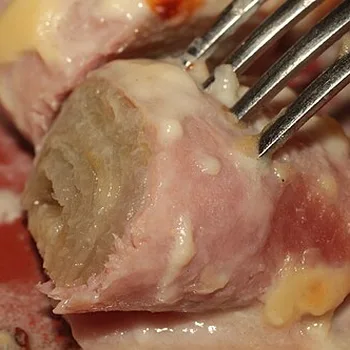
Belgian Chicory Gratin with Turkey Ham
Quick answer
A medium portion of Belgian Chicory Gratin with Turkey Ham (220 g) contains 286 kcal, with 7 g of net carbohydrates and 25.3 g of protein.
- Carbs13.2 g17.5%
- Protein25.3 g33.5%
- Fat16.5 g49.1%
- Fibre6.2 g
Percentages of total energy (calories)
Chicory, or Belgian endive (witloof), is the pride of the farms of Belgium and northern France, and its pleasant mild bitterness comes from natural plant compounds. In this dish the chicory heads are steamed, wrapped in slices of turkey ham, covered with a light Gouda cheese sauce and baked until golden. The result is a winter meal with good protein (about 11.5 g per 100 g) and very little available carbohydrate (about 3.2 g per 100 g), so the glycemic index does not apply and it barely raises blood sugar. Chicory itself is low in calories and provides fibre that benefits gut bacteria.
💡 Smart Nutritional Guidance
Consumption advice
Two wrapped chicory heads (220 g, about 286 kcal).
Best preparation methods
Steam the chicory well and press it gently before wrapping so the dish does not turn watery, make a light cheese sauce with semi-skimmed milk, and serve with a green salad.
Important Nutritional Note
Processed turkey ham and cheese add a noticeable amount of salt, so people with high blood pressure should eat it in moderation and add no salt to the sauce. Ingredient note: the traditional Belgian and French recipe uses cooked pork ham (hesp); our version uses turkey ham.
Nutrition facts
| Nutrient | Per 100 g | Per typical portion (220 g) |
|---|---|---|
| Calories | 130 kcal | 286 kcal |
| Protein | 11.5 g | 25.3 g |
| Carbohydrate | 6 g | 13.2 g |
| Available carbohydrate | 3.2 g | 7 g |
| Fat | 7.5 g | 16.5 g |
| Dietary fibre | 2.8 g | 6.2 g |
The typical portion is approximate, for comparison purposes.
Comparison & smarter alternatives
It has 130 kcal per 100 g, ranking 13 of 27 in Soups & home-cooked dishes (lowest first).
Related foods from the same family:
Frequently asked questions
Is Belgian Chicory Gratin with Turkey Ham good for weight loss?
It can be a useful part of a weight-loss plan because it provides 8.8 g of protein per 100 kcal, and protein supports fullness. A 220 g portion gives 286 kcal.
How does Belgian Chicory Gratin with Turkey Ham affect blood sugar?
Belgian Chicory Gratin with Turkey Ham contains only 3.2 g of available carbohydrate per 100 g, so the glycemic index does not apply and its direct effect on blood sugar is minimal. The meal’s effect depends on what you eat with it, such as bread, rice or sweetened sauces.
What is the nutritional value of a typical portion of Belgian Chicory Gratin with Turkey Ham?
A typical 220 g portion of Belgian Chicory Gratin with Turkey Ham provides about 286 kcal, 25.3 g protein, 13.2 g carbohydrate, 16.5 g fat and 6.2 g fibre.
Why is Belgian chicory a good choice for people with diabetes?
Because it is almost sugar-free and very low in calories, and its fibre adds bulk to the meal and helps you feel full. In this dish the turkey ham and cheese add protein, giving you a filling meal that hardly raises blood sugar.
How do you get rid of excess bitterness in chicory?
Cut out the small cone at the base of the head with a knife before cooking, as it holds most of the bitterness, and steam it with a squeeze of lemon and some nutmeg.
Does it suit older people and the DASH diet for blood pressure?
Chicory itself is excellent for DASH, but processed turkey ham and the cheese sauce raise the salt. Choose low-salt turkey ham, use a moderate amount of cheese and add no salt to make the dish a good fit.
Read also
References & Scientific Sources
- The glycemic index does not apply because this food has less than 5 g of available carbohydrate per 100 g, and a GI test requires 25 to 50 g of available carbohydrate, per: ISO 26642:2010. Food products — Determination of the glycaemic index (GI) and recommendation for food classification. International Organization for Standardization; 2010. www.iso.org/standard/43633.html
- Definition of available carbohydrate and glycemic load: FAO/WHO. Carbohydrates in human nutrition: report of a joint FAO/WHO expert consultation. FAO Food and Nutrition Paper 66. Rome; 1998. www.fao.org/4/w8079e/w8079e00.htm
Reviewed by Dr. Wassim Habib · Last reviewed 21 October 2026
Disclaimer: This guidance is for nutritional lifestyle orientation and does not constitute a diagnostic medical device under EU Regulation MDR 2017/745.