
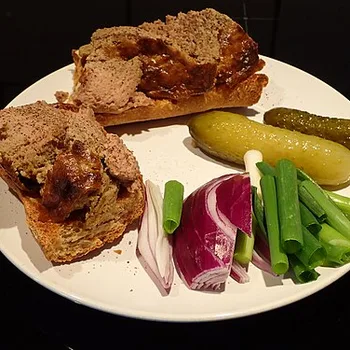
Smooth Chicken Liver Pâté
Quick answer
A medium portion of Smooth Chicken Liver Pâté (40 g) contains 124 kcal, with 1 g of net carbohydrates and 5.6 g of protein.
- Carbs1 g3.2%
- Protein5.6 g18.1%
- Fat10.8 g78.6%
- Fibre0 g
Percentages of total energy (calories)
Liver is one of the most nutrient-rich foods there is, and the French turned it into a smooth, velvety spread you can scoop with a spoon. Two spoonfuls of this pâté on a slice of wholegrain bread or cucumber slices give you a large amount of vitamin B12, easily absorbed iron, folate and vitamin A. That can help people who are low in iron or vitamin B12, although the cause of ongoing tiredness is something your doctor should check with blood tests. It has very little carbohydrate, so the glycemic index does not apply, but it is rich in fat (about 27 g per 100 g) from butter, and in vitamin A, which you should not overdo.
💡 Smart Nutritional Guidance
Consumption advice
Two spoonfuls (40 g, about 124 kcal), once a week.
Best preparation methods
Spread it on wholegrain seed crackers or cucumber and sweet pepper slices instead of white baguette, and top with fresh parsley or thyme.
Important Nutritional Note
Pregnant women are advised to avoid it completely, because of its high vitamin A (retinol) and the Listeria risk in pâté. People with gout should avoid it because it is rich in purines. Ingredient note: traditional French recipes often add cognac or port, and some add pork fat; if you prefer an alcohol-free or chicken-only version, look for one that says so on the label, or make it at home with chicken stock.
Nutrition facts
| Nutrient | Per 100 g | Per typical portion (40 g) |
|---|---|---|
| Calories | 310 kcal | 124 kcal |
| Protein | 14 g | 5.6 g |
| Carbohydrate | 2.5 g | 1 g |
| Available carbohydrate | 2.5 g | 1 g |
| Fat | 27 g | 10.8 g |
| Dietary fibre | 0 g | 0 g |
The typical portion is approximate, for comparison purposes.
Comparison & smarter alternatives
It provides 4.5 g of protein per 100 kcal, ranking 68 of 70 in Meat, fish & eggs (highest first).
Related foods from the same family:
Frequently asked questions
Is Smooth Chicken Liver Pâté good for weight loss?
It can fit a balanced plan with portion control: a 40 g portion gives 124 kcal, and what matters most is your total daily intake and the rest of the meal.
How does Smooth Chicken Liver Pâté affect blood sugar?
Smooth Chicken Liver Pâté contains only 2.5 g of available carbohydrate per 100 g, so the glycemic index does not apply and its direct effect on blood sugar is minimal. The meal’s effect depends on what you eat with it, such as bread, rice or sweetened sauces.
What is the nutritional value of a typical portion of Smooth Chicken Liver Pâté?
A typical 40 g portion of Smooth Chicken Liver Pâté provides about 124 kcal, 5.6 g protein, 1 g carbohydrate, 10.8 g fat and 0 g fibre.
Is chicken liver pâté suitable with insulin resistance?
Yes, it has very little carbohydrate, as long as you eat it with wholegrain seed crackers or sweet pepper slices instead of baguette and white bread, and stick to the portion because it is rich in fat.
How often a week is it recommended?
Once a week (a portion of about 40 g) is enough to benefit from the iron and vitamin B12 without overdoing the vitamin A and cholesterol that liver contains in abundance.
Does pâté raise uric acid and gout?
Yes, liver is rich in purines, so people with gout or high uric acid are advised to avoid it.
Read also
References & Scientific Sources
- The glycemic index does not apply because this food has less than 5 g of available carbohydrate per 100 g, and a GI test requires 25 to 50 g of available carbohydrate, per: ISO 26642:2010. Food products — Determination of the glycaemic index (GI) and recommendation for food classification. International Organization for Standardization; 2010. www.iso.org/standard/43633.html
- Definition of available carbohydrate and glycemic load: FAO/WHO. Carbohydrates in human nutrition: report of a joint FAO/WHO expert consultation. FAO Food and Nutrition Paper 66. Rome; 1998. www.fao.org/4/w8079e/w8079e00.htm
Reviewed by Dr. Wassim Habib · Last reviewed 21 October 2026
Disclaimer: This guidance is for nutritional lifestyle orientation and does not constitute a diagnostic medical device under EU Regulation MDR 2017/745.