
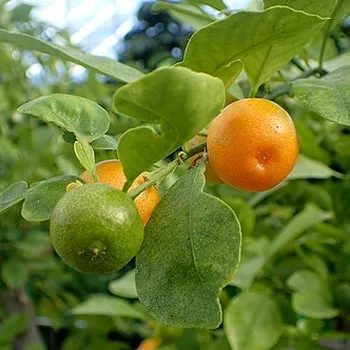
Calamansi (Philippine Lime)
Quick answer
A medium portion of Calamansi (Philippine Lime) (15 g) contains 4 kcal, with 0.7 g of net carbohydrates and 0.1 g of protein.
- Carbs1 g89.2%
- Protein0.1 g7.9%
- Fat0 g3%
- Fibre0.3 g
Percentages of total energy (calories)
A remarkable fruit the size of a marble, weighing only a few grams, yet an icon of the table in the Philippines and Southeast Asia! The fun contrast is that its thin skin, green or orange, tastes sweet, while the juice inside bursts with a sharp, refreshing sourness that wakes up your senses. Because a usual portion has very little carbohydrate, the glycemic index does not apply, and it becomes a tasty way to add strong flavour to food and drinks without sugar and without needing much salt.
💡 Smart Nutritional Guidance
Consumption advice
Two to three small fruits (about 15 to 20 g) with your meals of the day are enough for great flavour.
Best preparation methods
Do not peel it! Squeeze the whole fruit, thin skin and all, between your fingers over hot soup, grilled fish or a glass of iced green tea: the aromatic oils in the skin blend with the juice for a flavour that beats ordinary lime.
Important Nutritional Note
Wash the little fruits well under running water before squeezing them with the skin. If you have an active stomach ulcer or reflux, take it diluted and with food, not on an empty stomach.
Nutrition facts
| Nutrient | Per 100 g | Per typical portion (15 g) |
|---|---|---|
| Calories | 25 kcal | 3.8 kcal |
| Protein | 0.6 g | 0.1 g |
| Carbohydrate | 6.8 g | 1 g |
| Available carbohydrate | 4.8 g | 0.7 g |
| Fat | 0.1 g | 0 g |
| Dietary fibre | 2 g | 0.3 g |
The typical portion is approximate, for comparison purposes.
Comparison & smarter alternatives
It has 25 kcal per 100 g, ranking 1 of 65 in Fruit (lowest first).
Related foods from the same family:
Frequently asked questions
Is Calamansi (Philippine Lime) good for weight loss?
Yes. Calamansi (Philippine Lime) is very low in calories (25 kcal per 100 g), so you can eat a generous amount to add volume and fullness to a meal without many calories.
How does Calamansi (Philippine Lime) affect blood sugar?
Calamansi (Philippine Lime) contains only 4.8 g of available carbohydrate per 100 g, so the glycemic index does not apply and its direct effect on blood sugar is minimal. The meal’s effect depends on what you eat with it, such as bread, rice or sweetened sauces.
What is the nutritional value of a typical portion of Calamansi (Philippine Lime)?
A typical 15 g portion of Calamansi (Philippine Lime) provides about 4 kcal, 0.1 g protein, 1 g carbohydrate, 0 g fat and 0.3 g fibre.
Why squeeze calamansi whole, with its thin skin?
Because the skin is rich in aromatic oils and flavonoids such as hesperidin, which are not present in the same amounts in the juice alone. You get a deeper flavour and more natural antioxidants.
Does calamansi water break an intermittent fast?
A few drops in a glass of water contain very few calories and carbohydrates, so many people who fast intermittently consider it acceptable. If you add honey or sugar, it does break the fast.
Is it suitable if you have high blood pressure?
Yes. Its strong sour flavour makes food tasty with less salt, and cutting down on salt is one of the most important daily habits for managing blood pressure.
Read also
References & Scientific Sources
- The glycemic index does not apply because this food has less than 5 g of available carbohydrate per 100 g, and a GI test requires 25 to 50 g of available carbohydrate, per: ISO 26642:2010. Food products — Determination of the glycaemic index (GI) and recommendation for food classification. International Organization for Standardization; 2010. www.iso.org/standard/43633.html
- Definition of available carbohydrate and glycemic load: FAO/WHO. Carbohydrates in human nutrition: report of a joint FAO/WHO expert consultation. FAO Food and Nutrition Paper 66. Rome; 1998. www.fao.org/4/w8079e/w8079e00.htm
Reviewed by Dr. Wassim Habib · Last reviewed 20 October 2026
Disclaimer: This guidance is for nutritional lifestyle orientation and does not constitute a diagnostic medical device under EU Regulation MDR 2017/745.