
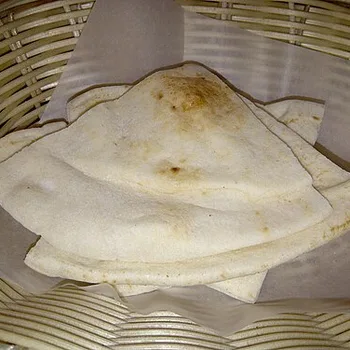
Grilled Arayes (Meat-Stuffed Pita)
Quick answer
A medium portion of Grilled Arayes (Meat-Stuffed Pita) (150 g) contains 465 kcal, with 44.7 g of net carbohydrates and 24 g of protein. Its glycemic index is 67 (Medium) for how fast it raises blood sugar, while its glycemic load per portion is 29.9 (High) for its actual effect.
- Carbs48 g40.3%
- Protein24 g20.1%
- Fat21 g39.6%
- Fibre3.3 g
Percentages of total energy (calories)
How many calories are in arayes?
Arayes is the sandwich nobody says no to: Arabic bread stuffed with minced meat with onion, parsley and spices, grilled over charcoal until crisp. There are 310 calories per 100 g, and two stuffed loaves (about 150 g) have about 465 calories, with about 24 g of protein and 21 g of fat.
Does arayes raise blood sugar?
Meat has no carbohydrate, so all the work here falls on the Arabic bread. White Arabic bread was measured in an Emirati study and came out with an index of 67, which means medium, so we used the same figure for arayes.
In terms of amount, the glycemic load of two loaves is about 30, which means high. The good news is that the fat and protein in the meat usually slow absorption a little.
Where are the hidden calories?
- The fat in the meat: fatty minced meat adds a lot of calories.
- The oil on the bread before grilling.
- The sauces: tahini and garlic sauce add dozens of calories per spoon.
How to eat them smartly
- Order or make arayes with lean meat.
- Brown bread or grain bread instead of white.
- You can eat them with a big salad (fattoush without fried bread, or tabbouleh) instead of fries.
- Keep it to one loaf with the salad, and that is enough.
Lighter alternatives
- Instead of white Arabic bread (67): grain bread, or Emirati khameer bread (47 in the same study).
- Instead of two loaves with fries: one loaf with a big salad and yoghurt.
Nutrition facts
| Nutrient | Per 100 g | Per typical portion (150 g) |
|---|---|---|
| Calories | 310 kcal | 465 kcal |
| Protein | 16 g | 24 g |
| Carbohydrate | 32 g | 48 g |
| Available carbohydrate | 29.8 g | 44.7 g |
| Sugar | not available | — |
| Fat | 14 g | 21 g |
| Dietary fibre | 2.2 g | 3.3 g |
| Glycemic index | 67 · Medium | |
| Glycemic load | — | 29.9 |
| Insulin index | not tested | |
The typical portion is approximate, for comparison purposes.
Comparison & smarter alternatives
Among the foods in Arabic dishes with a glycemic index (47), it ranks 47 (lowest first).
Frequently asked questions
How many calories are in arayes?
310 calories per 100 g, and two stuffed loaves (about 150 g) have about 465 calories.
Does arayes raise blood sugar?
Its index is medium (about 67, from the Arabic bread), but the load of two loaves is high (about 30).
Is arayes suitable for weight loss?
It can be, as one loaf with lean meat and a big salad.
How do I cut the calories in arayes?
Lean meat, less oil on the bread, and brown bread.
Read also
- HbA1c & Insulin Resistance: Comprehensive Clinical GuideArticle
- Prediabetes: How to Stop the Train and Lower Your HbA1cGuide
References & Scientific Sources
- The glycemic index of this food is a clinically reviewed estimate by the WiBo Health medical team, not a laboratory measurement from the International GI Tables (Atkinson 2021). GI bands (low ≤ 55 · medium 56–69 · high ≥ 70) follow: ISO 26642:2010. Food products — Determination of the glycaemic index (GI) and recommendation for food classification. International Organization for Standardization; 2010. www.iso.org/standard/43633.html
- The glycemic index of this food is calculated with the FAO/WHO formula for mixed meals: all the available carbohydrate in arayes comes from Arabic bread (67 ± 5), and meat contains no carbohydrate, so the dish's index equals the bread's index. It is not a direct laboratory measurement of arayes. Al Dhaheri AS et al. Br J Nutr. 2017;117:1110–7 · FAO/WHO. Carbohydrates in human nutrition. FAO Food and Nutrition Paper 66. Rome; 1998.
- Definition of available carbohydrate and glycemic load: FAO/WHO. Carbohydrates in human nutrition: report of a joint FAO/WHO expert consultation. FAO Food and Nutrition Paper 66. Rome; 1998. www.fao.org/4/w8079e/w8079e00.htm
Medically reviewed by Dr. Wassim Habib | Founder, WiBo Health · 31 October 2026
Disclaimer: This guidance is for nutritional lifestyle orientation and does not constitute a diagnostic medical device under EU Regulation MDR 2017/745.