
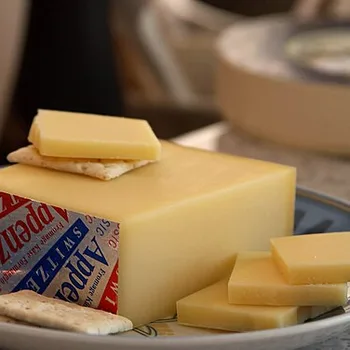
Appenzeller Cheese
Quick answer
A medium portion of Appenzeller Cheese (30 g) contains 118 kcal, with 0.1 g of net carbohydrates and 8.1 g of protein.
- Carbs0.1 g0.5%
- Protein8.1 g27.1%
- Fat9.6 g72.4%
- Fibre0 g
Percentages of total energy (calories)
One of Switzerland's oldest cheeses, made for more than 700 years in the green Appenzell region! Its legendary secret, which the Swiss guard closely, is the "secret herbal brine" (Kräutersulz) made from dozens of mountain plants and flowers, used to wash the rind regularly throughout the months of ageing. The result is a firm, amber cheese with a warm herbal flavour, rich in protein and almost free of lactose and carbohydrate, so the glycemic index does not apply.
💡 Smart Nutritional Guidance
Consumption advice
Two thin slices (30 g, about 118 kcal).
Best preparation methods
Enjoy it with a warm herbal tea or your morning coffee for a filling mountain breakfast that keeps hunger away until midday, or cut it into small cubes with olives for an elegant low-carb appetiser.
Important Nutritional Note
Like most traditional Swiss cheeses, it is usually made with calf rennet, so if you keep halal, look for a microbial rennet label. It is rich in salt, so stick to the portion if you watch your blood pressure.
Nutrition facts
| Nutrient | Per 100 g | Per typical portion (30 g) |
|---|---|---|
| Calories | 395 kcal | 118.5 kcal |
| Protein | 27 g | 8.1 g |
| Carbohydrate | 0.5 g | 0.1 g |
| Available carbohydrate | 0.5 g | 0.1 g |
| Fat | 32 g | 9.6 g |
| Dietary fibre | 0 g | 0 g |
The typical portion is approximate, for comparison purposes.
Comparison & smarter alternatives
It provides 6.8 g of protein per 100 kcal, ranking 25 of 46 in Dairy & cheese (highest first).
Related foods from the same family:
Frequently asked questions
Is Appenzeller Cheese good for weight loss?
It can fit a balanced plan with portion control: a 30 g portion gives 119 kcal, and what matters most is your total daily intake and the rest of the meal.
How does Appenzeller Cheese affect blood sugar?
Appenzeller Cheese contains only 0.5 g of available carbohydrate per 100 g, so the glycemic index does not apply and its direct effect on blood sugar is minimal. The meal’s effect depends on what you eat with it, such as bread, rice or sweetened sauces.
What is the nutritional value of a typical portion of Appenzeller Cheese?
A typical 30 g portion of Appenzeller Cheese provides about 119 kcal, 8.1 g protein, 0.1 g carbohydrate, 9.6 g fat and 0 g fibre.
Does the herbal brine add sugar or carbohydrate to Appenzeller?
No. The brine is used only to wash the outer rind, giving flavour and protecting it from drying out, and the cheese stays almost free of sugar and carbohydrate.
Why is Appenzeller easy to digest if you are lactose intolerant?
Because the long ageing turns almost all the lactose into lactic acid, so the cheese is nearly lactose-free and most people with lactose intolerance tolerate it.
What do the silver, gold and black Appenzeller labels mean?
Silver (Classic) is aged about 3 months and mild, gold (Surchoix) is aged 4 to 6 months with a stronger herbal flavour, and black (Extra) is aged over 6 months with a sharp, concentrated flavour.
Read also
References & Scientific Sources
- The glycemic index does not apply because this food has less than 5 g of available carbohydrate per 100 g, and a GI test requires 25 to 50 g of available carbohydrate, per: ISO 26642:2010. Food products — Determination of the glycaemic index (GI) and recommendation for food classification. International Organization for Standardization; 2010. www.iso.org/standard/43633.html
- Definition of available carbohydrate and glycemic load: FAO/WHO. Carbohydrates in human nutrition: report of a joint FAO/WHO expert consultation. FAO Food and Nutrition Paper 66. Rome; 1998. www.fao.org/4/w8079e/w8079e00.htm
Reviewed by Dr. Wassim Habib · Last reviewed 20 October 2026
Disclaimer: This guidance is for nutritional lifestyle orientation and does not constitute a diagnostic medical device under EU Regulation MDR 2017/745.