
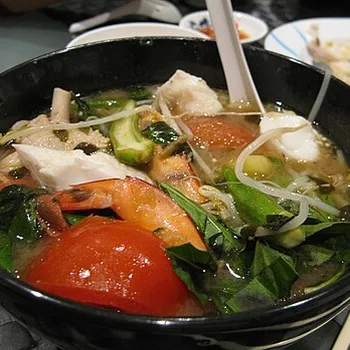
Vietnamese Sour Fish Soup (Canh Chua)
Quick answer
A medium portion of Vietnamese Sour Fish Soup (Canh Chua) (300 g) contains 255 kcal, with 18.3 g of net carbohydrates and 30 g of protein. Its glycemic index is 35 (Low) for how fast it raises blood sugar, while its glycemic load per portion is 6.4 (Low) for its actual effect.
- Carbs22.5 g34.8%
- Protein30 g46.4%
- Fat5.4 g18.8%
- Fibre4.2 g
Percentages of total energy (calories)
Canh chua is one of the best-known dishes of Vietnam’s Mekong Delta: a clear fish soup that balances refreshing sourness with herbal flavour. It is made with white freshwater fish, tamarind, pineapple, tomato, okra and bean sprouts. It is an excellent choice for weight loss, providing 10g of protein with only 85 kcal per 100g and very little fat (1.8g). The sourness of tamarind and pineapple gives a strong flavour that reduces the need for salt when you cook it at home.
💡 Smart Nutritional Guidance
Consumption advice
A large 300g bowl gives you about 255 kcal and 30g of protein, ideal for cutting diets and for anyone who wants a big meal with few calories.
Best preparation methods
Do not boil the fish pieces for long or they lose their tenderness, and add Vietnamese herbs and fresh mint at the last moment to keep their flavour.
Important Nutritional Note
Some restaurants add a lot of cane sugar to balance the tamarind, and use salty fish sauce; ask for less sweetness and less salt if you have diabetes or high blood pressure.
Nutrition facts
| Nutrient | Per 100 g | Per typical portion (300 g) |
|---|---|---|
| Calories | 85 kcal | 255 kcal |
| Protein | 10 g | 30 g |
| Carbohydrate | 7.5 g | 22.5 g |
| Available carbohydrate | 6.1 g | 18.3 g |
| Fat | 1.8 g | 5.4 g |
| Dietary fibre | 1.4 g | 4.2 g |
The typical portion is approximate, for comparison purposes.
Comparison & smarter alternatives
Among the foods in Asian dishes with a glycemic index (33), it ranks 11 (lowest first).
Smart alternatives from the same family:
Frequently asked questions
Is Vietnamese Sour Fish Soup (Canh Chua) good for weight loss?
It can be a useful part of a weight-loss plan because it provides 11.8 g of protein per 100 kcal, and protein supports fullness. A 300 g portion gives 255 kcal.
How does Vietnamese Sour Fish Soup (Canh Chua) affect blood sugar?
Its glycemic index is 35 (Low), a clinically reviewed estimate rather than a laboratory measurement. A typical 300 g portion has a glycemic load of 6.4 (Low), so the effect of this portion on blood sugar is limited.
What is the nutritional value of a typical portion of Vietnamese Sour Fish Soup (Canh Chua)?
A typical 300 g portion of Vietnamese Sour Fish Soup (Canh Chua) provides about 255 kcal, 30 g protein, 22.5 g carbohydrate, 5.4 g fat and 4.2 g fibre.
Is canh chua suitable for high blood pressure and the DASH diet?
It can be, if made with little salt and fish sauce: the tamarind sourness and herbs reduce the need for salt, and tomato and okra add potassium. Restaurant versions, however, can be high in sodium.
What is the glycemic index of this sour fish soup?
Its glycemic index is low (35) and the glycemic load of a bowl is about 6.4. The high protein and low starch content mean its effect on blood sugar is small.
Does this soup help with bloating and indigestion?
It is a light, easily digested soup, but the bromelain enzyme in pineapple is largely destroyed by cooking, so no special digestive effect should be expected. Its main benefit is that it is a light, low-fat meal.
Read also
- Prediabetes: How to Stop the Train and Lower Your HbA1cGuide
- Gestational Diabetes Guide: Normal Levels and Foods to EatGuide
References & Scientific Sources
- The glycemic index of this food is a clinically reviewed estimate by the WiBo Health medical team, not a laboratory measurement from the International GI Tables (Atkinson 2021). GI bands (low ≤ 55 · medium 56–69 · high ≥ 70) follow: ISO 26642:2010. Food products — Determination of the glycaemic index (GI) and recommendation for food classification. International Organization for Standardization; 2010. www.iso.org/standard/43633.html
- Definition of available carbohydrate and glycemic load: FAO/WHO. Carbohydrates in human nutrition: report of a joint FAO/WHO expert consultation. FAO Food and Nutrition Paper 66. Rome; 1998. www.fao.org/4/w8079e/w8079e00.htm
Reviewed by the WiBo Health medical team · Last reviewed 13 October 2026
Disclaimer: This guidance is for nutritional lifestyle orientation and does not constitute a diagnostic medical device under EU Regulation MDR 2017/745.