
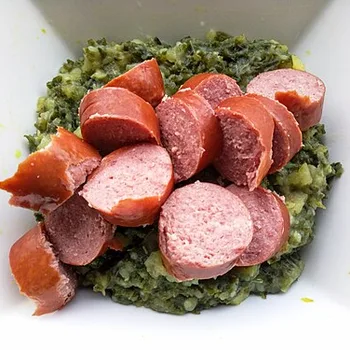
Traditional Dutch Smoked Sausage (Rookworst)
Quick answer
A medium portion of Traditional Dutch Smoked Sausage (Rookworst) (80 g) contains 248 kcal, with 2 g of net carbohydrates and 10.8 g of protein.
- Carbs2 g3.2%
- Protein10.8 g17.1%
- Fat22.4 g79.7%
- Fibre0 g
Percentages of total energy (calories)
Rookworst is the best-known winter sausage in the Netherlands and the traditional partner of mashed dishes such as stamppot and split pea soup (erwtensoep). It is recognised by its glossy brown skin, juicy filling and smoky flavour. Nutritionally it provides 13.5g of protein per 100g with a high fat content (28g), so it is filling and energy-dense. It is, however, a smoked processed meat, which the International Agency for Research on Cancer classifies as Group 1, so it is best eaten occasionally and in measured amounts.
💡 Smart Nutritional Guidance
Consumption advice
A moderate portion is half a sausage (about 70 to 80g) with mashed vegetable dishes rich in potassium, such as spinach, kale and cabbage.
Best preparation methods
Heat it in its casing in water just below the boil for about 15 minutes, without a rolling boil, so the skin does not burst and lose its juices.
Important Nutritional Note
The traditional Dutch recipe is made from pork (varkensvlees) and pork fat, but beef (runderrookworst) and chicken versions exist, including certified halal ones; check the label, for example with the Boodi scanner. Like other cured meats it contains salt and nitrite, so limit it if you have high blood pressure or heart disease.
Nutrition facts
| Nutrient | Per 100 g | Per typical portion (80 g) |
|---|---|---|
| Calories | 310 kcal | 248 kcal |
| Protein | 13.5 g | 10.8 g |
| Carbohydrate | 2.5 g | 2 g |
| Available carbohydrate | 2.5 g | 2 g |
| Fat | 28 g | 22.4 g |
| Dietary fibre | 0 g | 0 g |
The typical portion is approximate, for comparison purposes.
Comparison & smarter alternatives
It provides 4.4 g of protein per 100 kcal, ranking 69 of 70 in Meat, fish & eggs (highest first).
Related foods from the same family:
Frequently asked questions
Is Traditional Dutch Smoked Sausage (Rookworst) good for weight loss?
It can fit a balanced plan with portion control: a 80 g portion gives 248 kcal, and what matters most is your total daily intake and the rest of the meal.
How does Traditional Dutch Smoked Sausage (Rookworst) affect blood sugar?
Traditional Dutch Smoked Sausage (Rookworst) contains only 2.5 g of available carbohydrate per 100 g, so the glycemic index does not apply and its direct effect on blood sugar is minimal. The meal’s effect depends on what you eat with it, such as bread, rice or sweetened sauces.
What is the nutritional value of a typical portion of Traditional Dutch Smoked Sausage (Rookworst)?
A typical 80 g portion of Traditional Dutch Smoked Sausage (Rookworst) provides about 248 kcal, 10.8 g protein, 2 g carbohydrate, 22.4 g fat and 0 g fibre.
Is rookworst suitable for keto?
Yes, it is very low in carbohydrate (about 2.5g per 100g) and high in fat and protein. Choose versions without added starch and eat it in moderation, because it is a processed meat.
Does rookworst affect blood sugar?
Its effect on blood sugar is negligible because it has so little carbohydrate, but its high saturated fat and salt deserve attention for heart and artery health.
How can I tell traditional rookworst from halal versions in the shop?
Read the Dutch label carefully: “varken” means pork, while alternatives say “rund” (beef) or “kip” (chicken). Only treat a product as halal if it carries a recognised halal certification mark.
Read also
References & Scientific Sources
- The glycemic index does not apply because this food has less than 5 g of available carbohydrate per 100 g, and a GI test requires 25 to 50 g of available carbohydrate, per: ISO 26642:2010. Food products — Determination of the glycaemic index (GI) and recommendation for food classification. International Organization for Standardization; 2010. www.iso.org/standard/43633.html
- Definition of available carbohydrate and glycemic load: FAO/WHO. Carbohydrates in human nutrition: report of a joint FAO/WHO expert consultation. FAO Food and Nutrition Paper 66. Rome; 1998. www.fao.org/4/w8079e/w8079e00.htm
Reviewed by the WiBo Health medical team · Last reviewed 13 October 2026
Disclaimer: This guidance is for nutritional lifestyle orientation and does not constitute a diagnostic medical device under EU Regulation MDR 2017/745.