
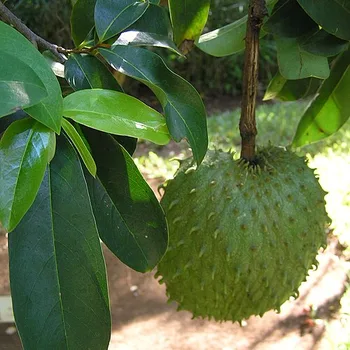
Soursop (Guanábana)
Quick answer
A medium portion of Soursop (Guanábana) (100 g) contains 66 kcal, with 13.5 g of net carbohydrates and 1 g of protein. Its glycemic index is 35 (Low) for how fast it raises blood sugar, while its glycemic load per portion is 4.7 (Low) for its actual effect.
- Carbs16.8 g90.9%
- Protein1 g5.4%
- Fat0.3 g3.7%
- Fibre3.3 g
Percentages of total energy (calories)
Taste soursop once and you will struggle to forget it! From the outside it looks like a strange, spiky green custard apple, but open it and you find bright white flesh with a smooth, creamy texture like a pudding or natural ice cream, and a lovely flavour that blends sweet strawberry, refreshing pineapple and a light citrus tang. The good news if you watch your blood sugar or are trying to lose weight: despite its rich tropical taste, its estimated glycemic index is low, around 35, and the glycemic load of a portion is very light (only about 4.7). The reason is its natural fibre (3.3 g per 100 g), which slows the absorption of sugar in the gut and keeps you comfortably full, giving you a luxurious tropical dessert for just 66 kcal per 100 g.
💡 Smart Nutritional Guidance
Consumption advice
The ideal portion is 100 g (about half a cup of pure white flesh). The best time to eat it is as a light, refreshing dessert after lunch, or as an afternoon snack with a pinch of cinnamon or a spoonful of plain yoghurt, so the sugar is absorbed more calmly and steadily.
Best preparation methods
Always eat it fresh with a spoon, with all its fibre, and avoid juicing or straining it: juice loses the fibre and lets its natural sugar reach your blood faster. For a summer touch, put the flesh in the freezer for half an hour and enjoy it as a natural alternative to supermarket ice cream full of added sugar.
Important Nutritional Note
Enjoy the white flesh in moderation, and set the black seeds aside: do not swallow or chew them. Also avoid drinking soursop leaf or seed tea in large amounts every day, as they contain natural compounds (such as annonacin) that are best not taken in excess.
Nutrition facts
| Nutrient | Per 100 g | Per typical portion (100 g) |
|---|---|---|
| Calories | 66 kcal | 66 kcal |
| Protein | 1 g | 1 g |
| Carbohydrate | 16.8 g | 16.8 g |
| Available carbohydrate | 13.5 g | 13.5 g |
| Fat | 0.3 g | 0.3 g |
| Dietary fibre | 3.3 g | 3.3 g |
The typical portion is approximate, for comparison purposes.
Comparison & smarter alternatives
Among the foods in Fruit with a glycemic index (57), it ranks 24 (lowest first).
Smart alternatives from the same family:
Frequently asked questions
Is Soursop (Guanábana) good for weight loss?
It can be included in moderation: it contains 3.3 g of fibre per 100 g, which supports fullness, and a 100 g portion gives 66 kcal.
How does Soursop (Guanábana) affect blood sugar?
Its glycemic index is 35 (Low), a clinically reviewed estimate rather than a laboratory measurement. A typical 100 g portion has a glycemic load of 4.7 (Low), so the effect of this portion on blood sugar is limited.
What is the nutritional value of a typical portion of Soursop (Guanábana)?
A typical 100 g portion of Soursop (Guanábana) provides about 66 kcal, 1 g protein, 16.8 g carbohydrate, 0.3 g fat and 3.3 g fibre.
Does soursop raise blood sugar after eating it?
It raises it slowly and gradually, without sharp spikes, as long as you eat the whole fruit in the suggested portion (100 g) with its natural fibre, without added sugar and without turning it into juice.
Is it true, as the internet claims, that soursop destroys cancer?
Laboratory research shows it contains antioxidants and active compounds, but there is no evidence that it prevents or destroys cancer in people, and it is no substitute for any medicine. It is simply a tasty, nourishing fruit that fits a balanced lifestyle.
How do I know a soursop is ripe and ready to eat?
When the green skin turns slightly soft and gives under gentle finger pressure, like a ripe avocado, and its colour shifts towards a darker, slightly yellowish green.
Read also
- Prediabetes: How to Stop the Train and Lower Your HbA1cGuide
- Gestational Diabetes Guide: Normal Levels and Foods to EatGuide
References & Scientific Sources
- The glycemic index of this food is a clinically reviewed estimate by the WiBo Health medical team, not a laboratory measurement from the International GI Tables (Atkinson 2021). GI bands (low ≤ 55 · medium 56–69 · high ≥ 70) follow: ISO 26642:2010. Food products — Determination of the glycaemic index (GI) and recommendation for food classification. International Organization for Standardization; 2010. www.iso.org/standard/43633.html
- Definition of available carbohydrate and glycemic load: FAO/WHO. Carbohydrates in human nutrition: report of a joint FAO/WHO expert consultation. FAO Food and Nutrition Paper 66. Rome; 1998. www.fao.org/4/w8079e/w8079e00.htm
Reviewed by Dr. Wassim Habib · Last reviewed 20 October 2026
Disclaimer: This guidance is for nutritional lifestyle orientation and does not constitute a diagnostic medical device under EU Regulation MDR 2017/745.