
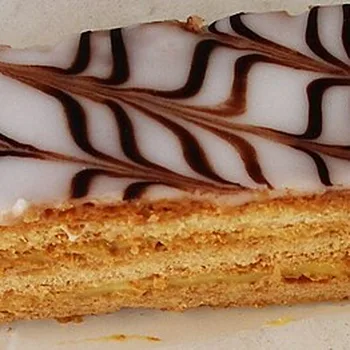
French Mille-Feuille (Tompouce)
Quick answer
A medium portion of French Mille-Feuille (Tompouce) (100 g) contains 377 kcal, with 38 g of net carbohydrates and 4.8 g of protein. Its glycemic index is 68 (Medium) for how fast it raises blood sugar, while its glycemic load per portion is 25.8 (High) for its actual effect.
- Carbs39 g40.8%
- Protein4.8 g5%
- Fat23 g54.2%
- Fibre1 g
Percentages of total energy (calories)
The time-honoured French “thousand-leaf” pastry, famous for its legendary crunch and many flaky layers, known in the Netherlands and Belgium as the tompouce with its glossy pink icing. It is made from crisp, buttery puff pastry layered with generous amounts of thick pastry cream (crème pâtissière). Loved around the world, it is nonetheless an energy-dense dessert with quickly digested starch, so it needs special care and careful counting in weight and blood sugar management plans.
💡 Smart Nutritional Guidance
Consumption advice
Share a slice with a friend or eat only half, and skip sweetened drinks or juice alongside it; a cup of green tea or unsweetened coffee is the ideal partner to balance the taste.
Best preparation methods
You can replace the white or pink sugar fondant with a very light dusting of cinnamon or unsweetened cocoa to cut simple sugars.
Important Nutritional Note
Its high glycemic load (25.8) means people with diabetes should be careful, fit it into their daily carbohydrate allowance, or take some activity such as a brisk walk after eating it.
Nutrition facts
| Nutrient | Per 100 g | Per typical portion (100 g) |
|---|---|---|
| Calories | 377 kcal | 377 kcal |
| Protein | 4.8 g | 4.8 g |
| Carbohydrate | 39 g | 39 g |
| Available carbohydrate | 38 g | 38 g |
| Fat | 23 g | 23 g |
| Dietary fibre | 1 g | 1 g |
The typical portion is approximate, for comparison purposes.
Comparison & smarter alternatives
Among the foods in Sweets & desserts with a glycemic index (54), it ranks 43 (lowest first).
Smart alternatives from the same family:
Frequently asked questions
Why does mille-feuille have a high glycemic load despite the custard?
The flaky pastry layers use a lot of refined flour, and the icing on top adds concentrated sugar, which raises the total fast-absorbed carbohydrate in a portion.
Is the Dutch tompouce different from the classic French mille-feuille?
The main differences are the thickness of the pink fondant icing and the firmer custard; both are very similar in calories and glycemic load.
How can I soften its effect on my energy during the day?
Make sure the meal before it is not starch-heavy; focus on protein and green, fibre-rich vegetables to slow overall digestion.
Read also
- HbA1c & Insulin Resistance: Comprehensive Clinical GuideArticle
- Prediabetes: How to Stop the Train and Lower Your HbA1cGuide
References & Scientific Sources
- The glycemic index of this food is a clinically reviewed estimate by the WiBo Health medical team, not a laboratory measurement from the International GI Tables (Atkinson 2021). GI bands (low ≤ 55 · medium 56–69 · high ≥ 70) follow: ISO 26642:2010. Food products — Determination of the glycaemic index (GI) and recommendation for food classification. International Organization for Standardization; 2010. www.iso.org/standard/43633.html
- Definition of available carbohydrate and glycemic load: FAO/WHO. Carbohydrates in human nutrition: report of a joint FAO/WHO expert consultation. FAO Food and Nutrition Paper 66. Rome; 1998. www.fao.org/4/w8079e/w8079e00.htm
Reviewed by the WiBo Health medical team · Last reviewed 13 October 2026
Disclaimer: This guidance is for nutritional lifestyle orientation and does not constitute a diagnostic medical device under EU Regulation MDR 2017/745.