Fattoush
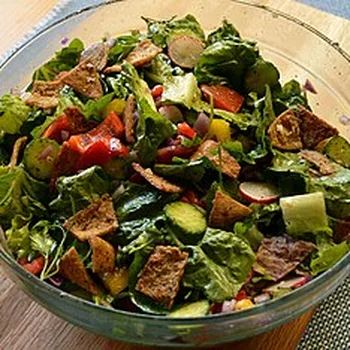
The cheerful salad of the oriental table, with colourful fresh vegetables, crunchy bread and sumac; its glycemic index is low (38), and it provides excellent hydration and plenty of fibre that helps keep blood sugar stable.
Glycemic index
Glycemic load
Calories
Protein
💡 Smart Nutritional Guidance
Consumption advice
A staple dish to break a fast or start lunch; the fibre in the leafy greens, radish and cucumber fills the stomach with few calories and slows the flow of glucose.
Best preparation methods
Toast pieces of wholegrain bread in the oven or air fryer with olive oil instead of frying them, and use 100% natural pomegranate molasses with no added sugar.
Important Nutritional Note
For people with diabetes or insulin resistance, it is always recommended to consider the total glycemic load (GL) of the meal rather than relying on the glycemic index alone.
Nutrition facts
| Nutrient | Per 100 g | Per typical portion (150 g) |
|---|---|---|
| Calories | 115 kcal | 172.5 kcal |
| Protein | 2.8 g | 4.2 g |
| Carbohydrate | 16 g | 24 g |
| Available carbohydrate | 13 g | 19.5 g |
| Fat | 5 g | 7.5 g |
| Dietary fibre | 3 g | 4.5 g |
The typical portion is approximate, for comparison purposes.
Comparison & smarter alternatives
Among the foods in Arabic dishes with a glycemic index (24), it ranks 8 (lowest first).
Smart alternatives from the same family:
Frequently asked questions
Is Fattoush good for weight loss?
It can be included in moderation: it contains 3 g of fibre per 100 g, which supports fullness, and a 150 g portion gives 172 kcal.
How does Fattoush affect blood sugar?
Its glycemic index is 38 (Low), a clinically reviewed estimate rather than a laboratory measurement. A typical 150 g portion has a glycemic load of 7.4 (Low), so the effect of this portion on blood sugar is limited.
What is the nutritional value of a typical portion of Fattoush?
A typical 150 g portion of Fattoush provides about 172 kcal, 4.2 g protein, 24 g carbohydrate, 7.5 g fat and 4.5 g fibre.
Reviewed by the WiBo Health medical team · Last reviewed 13 October 2026
Disclaimer: This guidance is for nutritional lifestyle orientation and does not constitute a diagnostic medical device under EU Regulation MDR 2017/745.