
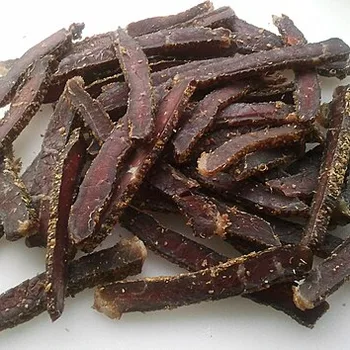
South African Beef Biltong
Quick answer
A medium portion of South African Beef Biltong (35 g) contains 93 kcal, with 0.2 g of net carbohydrates and 18.9 g of protein.
- Carbs0.4 g1.8%
- Protein18.9 g81.3%
- Fat1.8 g16.9%
- Fibre0.2 g
Percentages of total energy (calories)
Unlike many American beef jerkies, which are sweetened with sugar and soy sauce, South African biltong is the art of air-drying meat after soaking it in vinegar, toasted coriander seed, black pepper and salt. The result is tender slices of meat that are more than half protein by weight (about 54 g per 100 g), a good source of iron and zinc, with no sugar added in the traditional recipe. It has almost no carbohydrate, so the glycemic index does not apply. A practical snack for work or the car that keeps you full for a long time and helps you resist sweet cravings.
💡 Smart Nutritional Guidance
Consumption advice
A small handful (35 g, about 93 kcal and 18.9 g protein).
Best preparation methods
Have it as a snack between meals with cucumber or cherry tomatoes, or slice it over a green salad instead of other processed meats.
Important Nutritional Note
It is high in sodium (preserved with salt and vinegar), so people with high blood pressure or fluid retention should limit it and drink enough water with it. It is dried, uncooked meat, so pregnant women are advised to avoid it because of the risk of toxoplasmosis.
Nutrition facts
| Nutrient | Per 100 g | Per typical portion (35 g) |
|---|---|---|
| Calories | 265 kcal | 92.8 kcal |
| Protein | 54 g | 18.9 g |
| Carbohydrate | 1.2 g | 0.4 g |
| Available carbohydrate | 0.7 g | 0.2 g |
| Fat | 5 g | 1.8 g |
| Dietary fibre | 0.5 g | 0.2 g |
The typical portion is approximate, for comparison purposes.
Comparison & smarter alternatives
It provides 20.4 g of protein per 100 kcal, ranking 16 of 70 in Meat, fish & eggs (highest first).
Related foods from the same family:
Frequently asked questions
Is South African Beef Biltong good for weight loss?
It can be a useful part of a weight-loss plan because it provides 20.4 g of protein per 100 kcal, and protein supports fullness. A 35 g portion gives 93 kcal.
How does South African Beef Biltong affect blood sugar?
South African Beef Biltong contains only 0.7 g of available carbohydrate per 100 g, so the glycemic index does not apply and its direct effect on blood sugar is minimal. The meal’s effect depends on what you eat with it, such as bread, rice or sweetened sauces.
What is the nutritional value of a typical portion of South African Beef Biltong?
A typical 35 g portion of South African Beef Biltong provides about 93 kcal, 18.9 g protein, 0.4 g carbohydrate, 1.8 g fat and 0.2 g fibre.
What is the difference between biltong and American beef jerky?
Jerky is usually cooked or smoked, and many brands add sugar, while biltong is air-dried without cooking and has no added sugar in the traditional recipe, so it is usually higher in protein and lower in carbohydrate, which suits people with diabetes better.
Does biltong suit a keto diet and intermittent fasting?
It suits keto well, with almost no carbohydrate and plenty of protein. With intermittent fasting, eat it within your eating window; it is a filling snack that barely raises blood sugar, although protein does trigger some insulin release, as any protein food does.
How many grams make a filling snack?
A small handful of 30 to 35 g is usually enough, giving you about 16 to 19 g of protein for under 100 kcal.
Read also
References & Scientific Sources
- The glycemic index does not apply because this food has less than 5 g of available carbohydrate per 100 g, and a GI test requires 25 to 50 g of available carbohydrate, per: ISO 26642:2010. Food products — Determination of the glycaemic index (GI) and recommendation for food classification. International Organization for Standardization; 2010. www.iso.org/standard/43633.html
- Definition of available carbohydrate and glycemic load: FAO/WHO. Carbohydrates in human nutrition: report of a joint FAO/WHO expert consultation. FAO Food and Nutrition Paper 66. Rome; 1998. www.fao.org/4/w8079e/w8079e00.htm
Reviewed by Dr. Wassim Habib · Last reviewed 21 October 2026
Disclaimer: This guidance is for nutritional lifestyle orientation and does not constitute a diagnostic medical device under EU Regulation MDR 2017/745.