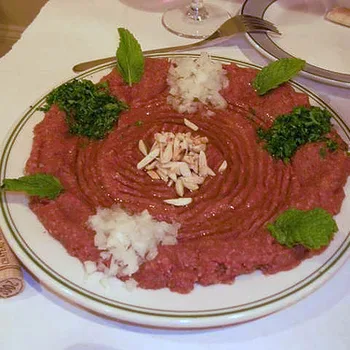
Raw Kibbeh
A refined heritage dish of the Levant: very fresh veal or lamb pounded with fine bulgur, mint and spices, with a very low glycemic index (38) and high-quality lean protein.
Glycemic index
Glycemic load
Calories
Protein
💡 Smart Nutritional Guidance
Consumption advice
A festive dish that suits people with diabetes or on a diet; it is very filling without raising blood sugar much, thanks to the high protein of the lean meat against a moderate amount of bulgur.
Best preparation methods
Serve it with extra virgin olive oil, fresh mint, rocket and spring onion, and always buy very fresh meat from a trusted source, as it is eaten raw.
Important Nutritional Note
⚠️ Only use completely fresh meat from a fully trusted source; raw kibbeh is not recommended for pregnant women, children or people with weakened immunity, to avoid the risk of bacterial infection.
Nutrition facts
| Nutrient | Per 100 g | Per typical portion (100 g) |
|---|---|---|
| Calories | 195 kcal | 195 kcal |
| Protein | 15 g | 15 g |
| Carbohydrate | 18 g | 18 g |
| Available carbohydrate | 15 g | 15 g |
| Fat | 7 g | 7 g |
| Dietary fibre | 3 g | 3 g |
The typical portion is approximate, for comparison purposes.
Comparison & smarter alternatives
Among the foods in Arabic dishes with a glycemic index (24), it ranks 9 (lowest first).
Smart alternatives from the same family:
Frequently asked questions
Is Raw Kibbeh good for weight loss?
It can be included in moderation: it contains 3 g of fibre per 100 g, which supports fullness, and a 100 g portion gives 195 kcal.
How does Raw Kibbeh affect blood sugar?
Its glycemic index is 38 (Low), a clinically reviewed estimate rather than a laboratory measurement. A typical 100 g portion has a glycemic load of 5.7 (Low), so the effect of this portion on blood sugar is limited.
What is the nutritional value of a typical portion of Raw Kibbeh?
A typical 100 g portion of Raw Kibbeh provides about 195 kcal, 15 g protein, 18 g carbohydrate, 7 g fat and 3 g fibre.
Reviewed by the WiBo Health medical team · Last reviewed 13 October 2026
Disclaimer: This guidance is for nutritional lifestyle orientation and does not constitute a diagnostic medical device under EU Regulation MDR 2017/745.