
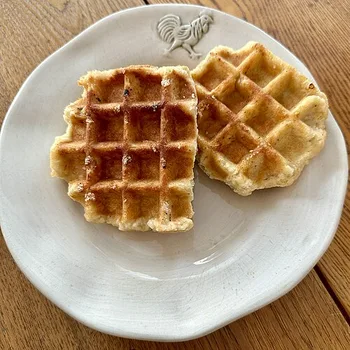
Liège Waffle with Pearl Sugar
Quick answer
A medium portion of Liège Waffle with Pearl Sugar (100 g) contains 420 kcal, with 52.2 g of net carbohydrates and 5.5 g of protein. Its glycemic index is 75 (High) for how fast it raises blood sugar, while its glycemic load per portion is 39.1 (High) for its actual effect.
- Carbs54 g51.7%
- Protein5.5 g5.3%
- Fat20 g43.1%
- Fibre1.8 g
Percentages of total energy (calories)
Here we have one of the most tempting and richest sweets in Europe! The Liège waffle is different from the light Brussels waffle: it is made from a dense, butter-rich brioche dough studded with large sugar nibs called "pearl sugar" that melt and caramelise on the hot iron into a glassy, crunchy crust. One waffle (100 g) has about 420 kcal, as much as a full meal, and more than 50 g of available carbohydrate, much of it sugar. Our team estimates its glycemic index at about 75 (high), and its glycemic load is very high, so it raises blood sugar quickly. The smart trick: do not deny yourself one on a visit to Belgium, but share it with someone, eat it after a meal with protein and salad rather than on an empty stomach, and walk for 15 to 20 minutes afterwards to help your muscles use up the glucose.
💡 Smart Nutritional Guidance
Consumption advice
One waffle (100 g, about 420 kcal), ideally half.
Best preparation methods
Share it, eat it after a meal with protein and vegetables, skip extras such as melted chocolate and whipped cream, and walk for 15 to 20 minutes afterwards.
Important Nutritional Note
Its glycemic load is very high, so it is an occasional treat rather than everyday food, and not something for people with diabetes to eat on an empty stomach.
Nutrition facts
| Nutrient | Per 100 g | Per typical portion (100 g) |
|---|---|---|
| Calories | 420 kcal | 420 kcal |
| Protein | 5.5 g | 5.5 g |
| Carbohydrate | 54 g | 54 g |
| Available carbohydrate | 52.2 g | 52.2 g |
| Fat | 20 g | 20 g |
| Dietary fibre | 1.8 g | 1.8 g |
The typical portion is approximate, for comparison purposes.
Comparison & smarter alternatives
Among the foods in Sweets & desserts with a glycemic index (54), it ranks 53 (lowest first).
Smart alternatives from the same family:
Frequently asked questions
Is Liège Waffle with Pearl Sugar good for weight loss?
Liège Waffle with Pearl Sugar provides 420 kcal per 100 g, so it is high in calories and fits a weight-loss plan only in small, measured amounts; a 100 g portion gives 420 kcal.
How does Liège Waffle with Pearl Sugar affect blood sugar?
Its glycemic index is 75 (High), a clinically reviewed estimate rather than a laboratory measurement. A typical 100 g portion has a glycemic load of 39.1 (High), so it is best to reduce or split the portion and combine it with protein and fibre.
What is the nutritional value of a typical portion of Liège Waffle with Pearl Sugar?
A typical 100 g portion of Liège Waffle with Pearl Sugar provides about 420 kcal, 5.5 g protein, 54 g carbohydrate, 20 g fat and 1.8 g fibre.
Can people with diabetes eat a Liège waffle?
With great care: half a waffle after a main meal, followed by a walk, is possible on special occasions, but eating it regularly raises your HbA1c.
Why is a Liège waffle so much heavier than a Brussels waffle?
Because a Brussels waffle is made from a light, runny batter with whipped egg white, so it turns out airy and crisp, while a Liège waffle is a dense yeast dough rich in butter and pearl sugar.
Is it a good pre-workout meal?
For athletes doing long endurance training it can be a quick source of energy to fill glycogen stores; for non-athletes it is a lot of calories that easily exceed needs, and a simpler snack is a better choice.
Read also
- HbA1c & Insulin Resistance: Comprehensive Clinical GuideArticle
- Prediabetes: How to Stop the Train and Lower Your HbA1cGuide
References & Scientific Sources
- The glycemic index of this food is a clinically reviewed estimate by the WiBo Health medical team, not a laboratory measurement from the International GI Tables (Atkinson 2021). GI bands (low ≤ 55 · medium 56–69 · high ≥ 70) follow: ISO 26642:2010. Food products — Determination of the glycaemic index (GI) and recommendation for food classification. International Organization for Standardization; 2010. www.iso.org/standard/43633.html
- Definition of available carbohydrate and glycemic load: FAO/WHO. Carbohydrates in human nutrition: report of a joint FAO/WHO expert consultation. FAO Food and Nutrition Paper 66. Rome; 1998. www.fao.org/4/w8079e/w8079e00.htm
Reviewed by Dr. Wassim Habib · Last reviewed 21 October 2026
Disclaimer: This guidance is for nutritional lifestyle orientation and does not constitute a diagnostic medical device under EU Regulation MDR 2017/745.