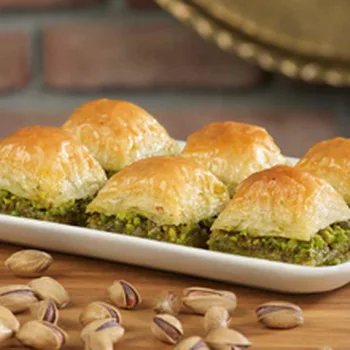
Baklava
The queen of luxurious oriental sweets: crisp layers of pastry filled with pistachios and soaked in syrup and ghee. Despite its intense sweetness, the fat of the pistachios and ghee slows its sugar a little (index 67), but its sugar and calorie density are very high.
Glycemic index
Glycemic load
Calories
Protein
💡 Smart Nutritional Guidance
Consumption advice
A sweet for happy occasions in a strict portion: just one small piece after a fibre-rich meal; avoid eating it on an empty stomach so it does not cause a sharp insulin spike.
Best preparation methods
Enjoy it with a cup of plain Arabic coffee and a pinch of cinnamon; the bitterness of the coffee balances the sweetness in your mouth.
Important Nutritional Note
For people with diabetes or insulin resistance, it is always recommended to consider the total glycemic load (GL) of the meal rather than relying on the glycemic index alone.
Nutrition facts
| Nutrient | Per 100 g | Per typical portion (40 g) |
|---|---|---|
| Calories | 428 kcal | 171.2 kcal |
| Protein | 6 g | 2.4 g |
| Carbohydrate | 51 g | 20.4 g |
| Available carbohydrate | 48.5 g | 19.4 g |
| Fat | 23 g | 9.2 g |
| Dietary fibre | 2.5 g | 1 g |
The typical portion is approximate, for comparison purposes.
Comparison & smarter alternatives
Among the foods in Sweets & desserts with a glycemic index (11), it ranks 7 (lowest first).
Lower-GI alternatives:
Frequently asked questions
Is Baklava good for weight loss?
Baklava provides 428 kcal per 100 g, so it is high in calories and fits a weight-loss plan only in small, measured amounts; a 40 g portion gives 171 kcal.
How does Baklava affect blood sugar?
Its glycemic index is 67 (Medium), a clinically reviewed estimate rather than a laboratory measurement. A typical 40 g portion has a glycemic load of 13 (Medium), so it is best combined with protein or fibre-rich vegetables.
What is the nutritional value of a typical portion of Baklava?
A typical 40 g portion of Baklava provides about 171 kcal, 2.4 g protein, 20.4 g carbohydrate, 9.2 g fat and 1 g fibre.
Reviewed by the WiBo Health medical team · Last reviewed 13 October 2026
Disclaimer: This guidance is for nutritional lifestyle orientation and does not constitute a diagnostic medical device under EU Regulation MDR 2017/745.