Healthy Sugar-Free Breakfast Cereals: The Best Supermarket Choices for Lasting Energy

Introduction: the "healthy breakfast" trap in the supermarket
Picture this everyday scene: you wake up motivated to have a healthy day, so you pour a bowl of cereal that the adverts call "rich in vitamins", "a source of fibre" and "good for your figure". Yet just two hours later your energy crashes, you feel sluggish, maybe a slight headache, and you crave something sweet or a second cup of coffee.
What happened? Many cereals sold as "healthy" or "fitness" are really dessert in disguise: some popular varieties, especially those aimed at children, contain 30–40% sugar by weight, which means almost one spoonful of sugar in every two spoonfuls of cereal.
In this practical guide, built on approved European standards, you will learn how to choose breakfast cereals with no added sugar, how to read the nutrition label, which options are actually on the shelves (in the Netherlands, elsewhere in Europe and in the Arab world), and how to keep your energy steady and your mind clear until lunch.
1. How does sugar hide in cereal boxes?
When you read the ingredients, "sugar" (suiker) may not be the first item, so the product seems lightly sweetened. But many manufacturers split the total sugar over 4 or 5 ingredients with different names, so each one drops down the list. If you see any of these names, it is added sugar:
- Glucose-fructose syrup (glucose-fructosestroop): a fast-absorbed industrial sugar; eating a lot of it is linked to more fat in the liver and around the belly.
- Maltodextrin: a processed starch with a glycaemic index higher than white sugar itself.
- Barley malt extract (gerstemoutextract): gives cereal a brown, "wholegrain" look along with extra sweetness.
- Other names: grape sugar, sucrose, dextrose, maple syrup and fruit juice concentrates.
The golden rule: a truly healthy cereal usually has a single line of ingredients, such as "100% whole oats".
2. Four numbers that decide in front of the shelf
To decide in seconds, remember these figures per 100 g of product. The sugar and fibre limits match the EU conditions for the claims "low sugar" and "high fibre":
Sugar (suikers)
If the pack says "no added sugar", the sugar in the table is the natural sugar of the grain itself.
Fibre (vezels)
Ideally 8–10 g. Fibre slows sugar absorption and eases the load on the pancreas.
Whole grain (volkoren)
Whole grain should be the first ingredient on the list.
Salt (zout)
The less salt, the better for your blood pressure.
3. Comparison and smart shopping guide
Instead of getting lost among dozens of brands, we sorted the common options into three clear groups:
Whole rolled oats (havermout)
Ingredients: 100% whole oats, nothing added.
Oats contain soluble beta-glucan fibre, which forms a gel in the gut; oat beta-glucan contributes to the maintenance of normal blood cholesterol levels (EFSA-authorised claim at 3 g a day), and it releases energy slowly over several hours.
Full nutrition facts for oats →Natural muesli (muesli zonder suiker)
Ingredients: flakes of oats, rye and whole wheat with linseed and raw nuts.
Note: choose untoasted muesli (ongetoast); crunchy muesli is usually baked with oil and sugar.
Nutrition facts for muesli →Shredded wheat (volkoren tarwe)
Ingredients: 100% whole wheat, shredded and steam-pressed.
Very rich in insoluble fibre that supports regular bowel movements, and free of salt and sugar. Its glycaemic index is fairly high, so add protein and nuts.
Unsweetened corn flakes
Ingredients: milled corn with a pinch of salt and added vitamins, without a sugar coating.
Tip: they are digested much faster than oats, so do not eat them on their own with skimmed milk. Always add protein and healthy fat (Greek yoghurt with a handful of walnuts or chia seeds) to slow the rise in blood sugar.
Nutrition facts for corn flakes →Crunchy granola and cruesli
The grains are mixed with oils and glucose syrup and then baked for crunch, so their sugar content comes close to a slice of cake.
Nutrition facts for granola →Coloured and chocolate cereals for children
High sugar and almost no fibre mean a fast rise in blood sugar, often followed by a dip in energy and focus before noon.
4. Why is a sugary breakfast linked to belly fat?
When you start the day with sweetened cereal, a quick chain of responses follows:
- A fast glucose spike: simple sugars reach the blood within minutes and blood sugar rises sharply.
- A large insulin release: the pancreas releases a lot of insulin to bring blood sugar back down.
- Fat burning is put on hold: while insulin is high, the body stops releasing stored fat for fuel and stores the extra sugar in the liver and muscles, and the rest as fat, including belly fat.
- A rebound dip (sugar crash): two or three hours later blood sugar may drop quickly, leaving you unfocused, hungry and craving pastries or sweets.
Whole, sugar-free, fibre-rich cereals keep the blood sugar curve calmer and insulin lower, which helps your body keep using its own fat for energy through the morning.
5. Smart toppings that make your bowl filling
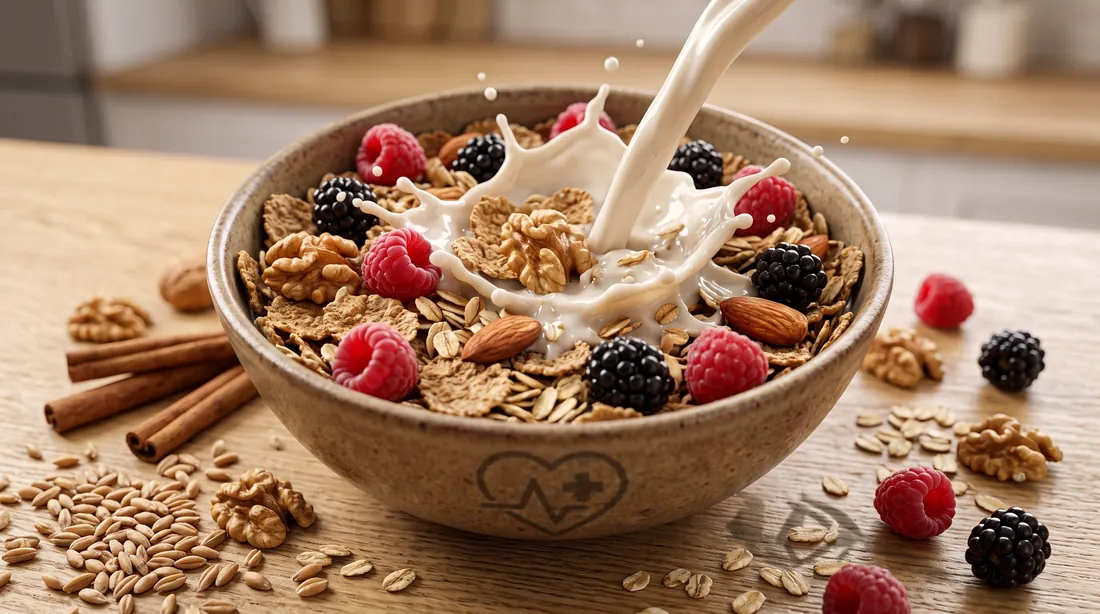
- Walnuts: one walnut (two halves) gives about 26 kcal of healthy fat and is rich in alpha-linolenic acid (plant omega-3).
- Raw cashews and almonds: a small handful (10–12 nuts) provides magnesium and zinc.
- Chia seeds and ground linseed: one tablespoon of chia adds about 4 g of fibre and absorbs water to form a gel that keeps you full for longer.
- Ceylon cinnamon: a warm, sweet taste without any sugar; some studies suggest it may support the body's response to insulin.
- Fresh berries: a low glycaemic index and plenty of antioxidant anthocyanins.
⚠️ Food allergy notice
- Gluten intolerance (coeliac disease): oats are naturally gluten-free but are often harvested and milled in facilities that also process wheat, so they get contaminated. People with coeliac disease should only buy certified gluten-free oats (glutenvrije haver).
- Tree nut and peanut allergy: avoid walnuts, cashews, almonds and peanut butter, and use sunflower seeds, pumpkin seeds or chia seeds instead.
- Lactose intolerance: use an unsweetened plant drink (such as soy or almond drink fortified with calcium and vitamin D) instead of cow's milk.
6. Check a cereal box in seconds with the Boodi app
Scan the barcode with your phone and Boodi shows the total sugar and hidden sugar names, the Nutri-Score, the halal status and doubtful ingredients (such as E471), and suggests lower-sugar alternatives from the same shelf.
7. Three quick sugar-free breakfast recipes
Overnight oats
Ingredients: 4 tablespoons of whole oats + 1 cup of unsweetened almond or oat drink + 1 teaspoon of chia seeds + a pinch of cinnamon + a handful of blueberries.
Method: mix everything in a jar, close it and put it in the fridge before bed. By morning it has the texture of a creamy pudding, ready to eat without cooking.
Muesli bowl with Greek yoghurt
Ingredients: 4 tablespoons of sugar-free natural muesli + 150 g full-fat Greek yoghurt + 4 walnuts + a sprinkle of ground linseed.
Value: about 15 g of protein plus healthy fats that keep hunger away until midday.
Warm cereal bowl
Ingredients: 1 cup of whole wheat flakes or oats + hot unsweetened milk + 1 teaspoon of 100% natural peanut butter (no palm oil or sugar).
Value: warm, stomach-friendly energy on cold mornings. Peanut allergy? Use sunflower seed butter instead.
8. Frequently asked questions
Is natural honey a safe way to sweeten cereal?
Honey contains antioxidants, but metabolically it is fructose and glucose and raises blood sugar and insulin like any other sugar. If you use it, keep it to half a teaspoon; better still, train your taste buds with cinnamon and fresh fruit.
Are sugar-free cereals suitable for people with insulin resistance?
Yes, especially oats and natural muesli, as long as you always combine them with protein and nuts to slow absorption and avoid sudden rises in blood sugar.
How can I tell muesli is sugar-free if the pack is in another language?
Look for waarvan suikers ("of which sugars") in the Dutch nutrition table; it should not exceed 5 g per 100 g. Or scan the barcode with the Boodi app for a translation and a clear rating.
Conclusion
Breakfast is more than a way to quiet morning hunger: it is the first signal that sets your hormones, focus and energy for hours. Swapping sugary cereals for whole grains with no added sugar is one of the simplest and most effective health decisions for your heart, your weight and your daily energy.
Scientific sources
- Regulation (EC) No 1924/2006, Annex: nutrition claims "low sugars" (≤5 g/100 g) and "high fibre" (≥6 g/100 g)
- EFSA Journal 2010;8(12):1885 (oat beta-glucan and lowering blood cholesterol)
- EFSA Journal 2011;9(6):2207 (beta-glucans from oats and barley and normal blood LDL-cholesterol)
- Atkinson FS et al. Am J Clin Nutr 2021 (International tables of glycemic index and glycemic load values) — PMID: 34258626
⚖️ Medical disclaimer: The information in this guide is provided by WiBo Health for general health and nutrition education, based on published research and the recommendations of the European Food Safety Authority (EFSA). It is not a medical diagnosis and does not replace a consultation with your doctor or a clinical dietitian.