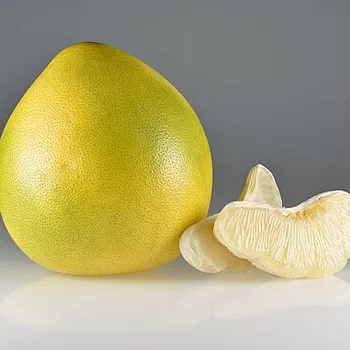
Sweet Pomelo
The largest of all citrus fruits and an ancestor of the grapefruit: a thick, spongy rind protects giant segments full of crisp juice with a soft, sweet flavour and almost no bitterness. Pomelo has a low glycemic index (≈30) and few calories.
Glycemic index
Glycemic load
Calories
Protein
💡 Smart Nutritional Guidance
Consumption advice
Two to three peeled segments as an afternoon snack fill your stomach with fibre and water and cover your full daily vitamin C needs without any worry about raising blood sugar.
Best preparation methods
Peel off the thick spongy rind and remove the tough white membranes around the segments, then eat the juicy pulp fresh and cold.
Important Nutritional Note
Rich in potassium and fibre that support healthy blood vessels; it carries the same drug warning as grapefruit, though to a lesser degree, so people taking statins should be careful.
Nutrition facts
| Nutrient | Per 100 g | Per typical portion (100 g) |
|---|---|---|
| Calories | 38 kcal | 38 kcal |
| Protein | 0.8 g | 0.8 g |
| Carbohydrate | 9.6 g | 9.6 g |
| Available carbohydrate | 8.6 g | 8.6 g |
| Fat | 0 g | 0 g |
| Dietary fibre | 1 g | 1 g |
The typical portion is approximate, for comparison purposes.
Comparison & smarter alternatives
Among the foods in Fruit with a glycemic index (43), it ranks 12 (lowest first).
Smart alternatives from the same family:
Frequently asked questions
Is Sweet Pomelo good for weight loss?
Yes. Sweet Pomelo is very low in calories (38 kcal per 100 g), so you can eat a generous amount to add volume and fullness to a meal without many calories.
How does Sweet Pomelo affect blood sugar?
Its glycemic index is 30 (Low), a clinically reviewed estimate rather than a laboratory measurement. A typical 100 g portion has a glycemic load of 2.6 (Low), so the effect of this portion on blood sugar is limited.
What is the nutritional value of a typical portion of Sweet Pomelo?
A typical 100 g portion of Sweet Pomelo provides about 38 kcal, 0.8 g protein, 9.6 g carbohydrate, 0 g fat and 1 g fibre.
Reviewed by the WiBo Health medical team · Last reviewed 13 October 2026
Disclaimer: This guidance is for nutritional lifestyle orientation and does not constitute a diagnostic medical device under EU Regulation MDR 2017/745.