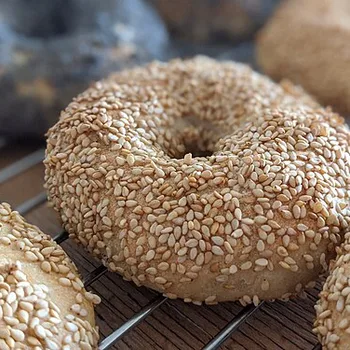
Sesame Bagel
New York's famous ring of bread with a dense, chewy texture and a glossy crust scattered with sesame seeds: it is boiled in water before baking to get its unique density. The dense white-flour dough gives it a high glycemic index (≈72) and a large carbohydrate load.
Glycemic index
Glycemic load
Calories
Protein
💡 Smart Nutritional Guidance
Consumption advice
Half a bagel is plenty for a meal; fill it generously with ricotta or smoked salmon and cucumber, because the protein and healthy fats slow the absorption of the dense dough.
Best preparation methods
Choose a whole-wheat bagel and scoop out some of the soft inner dough before filling it; this kitchen trick cuts the sandwich's carbohydrate by about a third.
Important Nutritional Note
One whole bagel can equal 4 to 5 slices of ordinary sandwich bread in starch, so sharing it or eating half is the smarter choice for people with diabetes or watching their weight.
Nutrition facts
| Nutrient | Per 100 g | Per typical portion (50 g) |
|---|---|---|
| Calories | 289 kcal | 144.5 kcal |
| Protein | 11 g | 5.5 g |
| Carbohydrate | 56 g | 28 g |
| Available carbohydrate | 53.7 g | 26.9 g |
| Fat | 2.1 g | 1.1 g |
| Dietary fibre | 2.3 g | 1.1 g |
The typical portion is approximate, for comparison purposes.
Comparison & smarter alternatives
Among the foods in Grains & starches with a glycemic index (35), it ranks 34 (lowest first).
Smart alternatives from the same family:
Frequently asked questions
Is Sesame Bagel good for weight loss?
It can fit a balanced plan with portion control: a 50 g portion gives 144 kcal, and what matters most is your total daily intake and the rest of the meal.
How does Sesame Bagel affect blood sugar?
Its glycemic index is 72 (High), a clinically reviewed estimate rather than a laboratory measurement. A typical 50 g portion has a glycemic load of 19.3 (Medium), so it is best combined with protein or fibre-rich vegetables.
What is the nutritional value of a typical portion of Sesame Bagel?
A typical 50 g portion of Sesame Bagel provides about 144 kcal, 5.5 g protein, 28 g carbohydrate, 1.1 g fat and 1.1 g fibre.
Reviewed by the WiBo Health medical team · Last reviewed 13 October 2026
Disclaimer: This guidance is for nutritional lifestyle orientation and does not constitute a diagnostic medical device under EU Regulation MDR 2017/745.