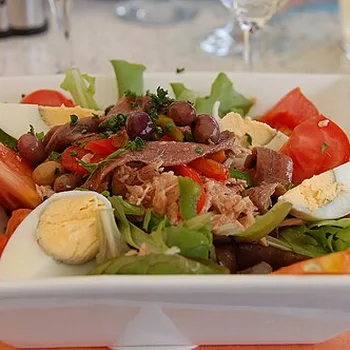
Salade Niçoise with Tuna & Eggs
Salade niçoise is the masterpiece of the French Riviera: tuna, boiled eggs, green beans, olives and tomatoes with an olive oil and mustard dressing. It has a very low glycemic index (clinically reviewed estimate ≈20) and is the perfect model of a complete, filling meal.
Glycemic index
Glycemic load
Calories
Protein
💡 Smart Nutritional Guidance
Consumption advice
A lunch in its own right: the protein of the tuna and eggs with the fibre of the vegetables keeps your energy steady with no craving for sweets all afternoon.
Best preparation methods
Blanch the green beans briefly so they stay crisp and green, and use tuna in olive oil or water with a spoonful of Dijon mustard and apple cider vinegar.
Important Nutritional Note
A meal rich in omega-3, choline, vitamin D and potassium that effectively helps improve insulin resistance and lower triglycerides.
Nutrition facts
| Nutrient | Per 100 g | Per typical portion (300 g) |
|---|---|---|
| Calories | 93 kcal | 279 kcal |
| Protein | 8 g | 24 g |
| Carbohydrate | 2.7 g | 8.1 g |
| Available carbohydrate | 1.4 g | 4.2 g |
| Fat | 5.3 g | 15.9 g |
| Dietary fibre | 1.3 g | 3.9 g |
The typical portion is approximate, for comparison purposes.
Comparison & smarter alternatives
Among the foods in Salads with a glycemic index (9), it ranks 2 (lowest first).
Smart alternatives from the same family:
Frequently asked questions
Is salade niçoise suitable for people with diabetes?
It is one of the best meals of all: its glycemic index and glycemic load are both very low, and it gives ideal fullness without any fast starch.
What is the nutritional value of a large plate of salade niçoise (300 g)?
A plate provides about 280 kcal, 24 g of excellent protein, 16 g of healthy fat and around 8 g of carbohydrate (4 g of it fibre).
Does adding a few small potatoes change its glycemic index?
Two small boiled and cooled potatoes add only about 10 g of starch, and the vinegar, oil and tuna keep the overall index low.
Reviewed by the WiBo Health medical team · Last reviewed 13 October 2026
Disclaimer: This guidance is for nutritional lifestyle orientation and does not constitute a diagnostic medical device under EU Regulation MDR 2017/745.