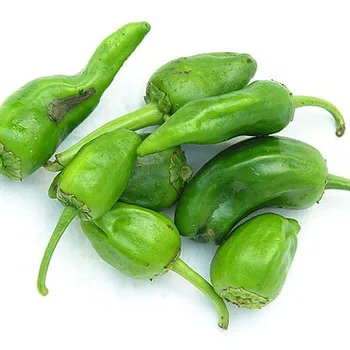
Padrón Peppers in Olive Oil
Padrón peppers blistered in olive oil with coarse sea salt are Spain's most famous tapa: small green peppers with a charming aromatic flavour and tasty surprises (about one in ten can be hot!). Their glycemic index does not apply, and they are a light, starch-free snack full of joy and flavour.
Glycemic index
Glycemic load
Calories
Protein
💡 Smart Nutritional Guidance
Consumption advice
Eat them hot from the pan as a satisfying vegetable starter alongside grilled meat and fish, to add fibre and support fat burning.
Best preparation methods
Sear the peppers in a very hot pan with extra virgin olive oil until they puff up and show light brown blisters, then take them off at once and sprinkle with coarse sea salt.
Important Nutritional Note
Very rich in vitamin C and mild capsaicin, which stimulate circulation and the basal metabolic rate without irritating a healthy stomach.
Nutrition facts
| Nutrient | Per 100 g | Per typical portion (100 g) |
|---|---|---|
| Calories | 55 kcal | 55 kcal |
| Protein | 1.5 g | 1.5 g |
| Carbohydrate | 4.2 g | 4.2 g |
| Available carbohydrate | 2.2 g | 2.2 g |
| Fat | 3.8 g | 3.8 g |
| Dietary fibre | 2 g | 2 g |
The typical portion is approximate, for comparison purposes.
Comparison & smarter alternatives
It has 55 kcal per 100 g, ranking 2 of 9 in Spanish dishes (lowest first).
Related foods from the same family:
Frequently asked questions
Are Padrón peppers allowed on keto and low-carb diets?
Yes, they are ideal: a light vegetable with almost no net carbohydrate, and the olive oil fat supports ketosis.
How many calories are in a 100 g portion of cooked Padrón peppers?
About 55 kcal (most of it from the healthy olive oil they absorb), with 1.5 g of protein and 2 g of excellent dietary fibre.
Are Padrón peppers very hot?
Most are sweet and aromatic; the famous Spanish saying goes 'some are hot and some are not', which makes eating them a fun experience.
Reviewed by the WiBo Health medical team · Last reviewed 13 October 2026
Disclaimer: This guidance is for nutritional lifestyle orientation and does not constitute a diagnostic medical device under EU Regulation MDR 2017/745.