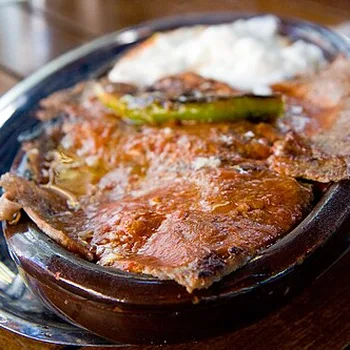
Iskender Kebab with Yogurt & Butter
İskender kebab is the pride of the Turkish city of Bursa: thin slices of döner meat over pieces of pide bread soaked in rich tomato sauce and melted butter, served with yoghurt. It has a low glycemic index (clinically reviewed estimate ≈45), as the fat of the meat and yoghurt brakes the absorption of the bread's starch.
Glycemic index
Glycemic load
Calories
Protein
💡 Smart Nutritional Guidance
Consumption advice
Start with the meat and the yoghurt, and keep to a few small pieces of the sauce-soaked bread at the bottom of the plate to control the carbohydrate.
Best preparation methods
Ask for just a light brush of butter instead of a generous pour of sizzling butter, to halve the saturated calories while keeping the royal flavour.
Important Nutritional Note
The yoghurt adds lactic acid and protein that slow stomach emptying, but the dish is high in calories and saturated fat and calls for strict moderation.
Nutrition facts
| Nutrient | Per 100 g | Per typical portion (300 g) |
|---|---|---|
| Calories | 173 kcal | 519 kcal |
| Protein | 11.3 g | 33.9 g |
| Carbohydrate | 10.7 g | 32.1 g |
| Available carbohydrate | 9.8 g | 29.4 g |
| Fat | 9.3 g | 27.9 g |
| Dietary fibre | 0.9 g | 2.7 g |
The typical portion is approximate, for comparison purposes.
Comparison & smarter alternatives
Among the foods in Turkish dishes with a glycemic index (7), it ranks 3 (lowest first).
Smart alternatives from the same family:
Frequently asked questions
Is İskender kebab suitable for people with diabetes?
Yes, with care: its glycemic index is low (≈45), but it is rich in both starch and fat, so don't eat all the bread under the meat.
What is the nutritional value of a typical plate of İskender kebab (300 g)?
A plate contains about 520 kcal, 34 g of excellent protein, 28 g of fat and around 32 g of starch.
What do the tomato sauce and yoghurt add to the dish?
The tomato sauce provides antioxidant lycopene, and the yoghurt adds calcium and helps the digestion of red meat.
Reviewed by the WiBo Health medical team · Last reviewed 13 October 2026
Disclaimer: This guidance is for nutritional lifestyle orientation and does not constitute a diagnostic medical device under EU Regulation MDR 2017/745.