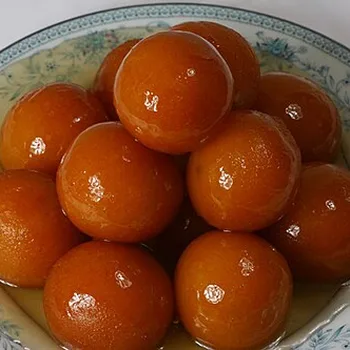
Gulab Jamun Milk Balls in Rose Syrup
Gulab jamun is the undisputed king of Indian and Pakistani sweets: soft golden balls made from dried milk solids (khoya), gently fried and soaked in fragrant sugar syrup with cardamom, rose water and saffron. It has a high glycemic index (clinically reviewed estimate ≈78) because it is a sugar-and-syrup bomb that calls for great caution.
Glycemic index
Glycemic load
Calories
Protein
💡 Smart Nutritional Guidance
Consumption advice
Keep to one very small ball on major holidays and special occasions, squeeze out the excess syrup before eating, and never eat it on an empty stomach.
Best preparation methods
You can bake the balls in an air fryer and soak them in a light syrup sweetened with stevia, rose water and saffron to soften their sharp sugar effect.
Important Nutritional Note
Strict clinical warning: a fast-absorbed sweet that combines deep frying in ghee with a full soak in syrup; it raises blood sugar and insulin very fast and strains the pancreas.
Nutrition facts
| Nutrient | Per 100 g | Per typical portion (50 g) |
|---|---|---|
| Calories | 380 kcal | 190 kcal |
| Protein | 5.5 g | 2.8 g |
| Carbohydrate | 64 g | 32 g |
| Available carbohydrate | 63.2 g | 31.6 g |
| Fat | 12 g | 6 g |
| Dietary fibre | 0.8 g | 0.4 g |
The typical portion is approximate, for comparison purposes.
Comparison & smarter alternatives
Among the foods in Sweets & desserts with a glycemic index (27), it ranks 27 (lowest first).
Smart alternatives from the same family:
Frequently asked questions
Is gulab jamun forbidden for people with diabetes?
It is best avoided completely; if you want a taste, have half a small ball after a complete meal and check your blood sugar carefully.
How many calories are in two gulab jamun (50 g)?
The portion contains about 190 kcal, 3 g of protein, 6 g of fat and around 32 g of fast-absorbed sugars.
Why is it called 'gulab jamun'?
'Gulab' means rose water in Persian, and 'jamun' refers to the dark Indian jambul fruit, which it resembles in size and shape.
Reviewed by the WiBo Health medical team · Last reviewed 13 October 2026
Disclaimer: This guidance is for nutritional lifestyle orientation and does not constitute a diagnostic medical device under EU Regulation MDR 2017/745.