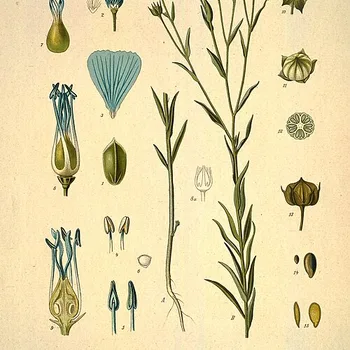
Freshly Cold-Milled Flaxseeds
A treasure of plant omega-3 and a leading cholesterol fighter: small golden or brown seeds whose grinding releases their oil and protective lignans; with water they turn into a gel that soothes the stomach lining and feeds the gut microbiome.
Glycemic index
Glycemic load
Calories
Protein
💡 Smart Nutritional Guidance
Consumption advice
Take one tablespoon of ground flaxseed a day (10 g) with a glass of warm water or with buttermilk; whole seeds pass through the gut unabsorbed, so freshly grinding them is essential.
Best preparation methods
Grind only enough for one week and keep it in a dark glass jar in the fridge; omega-3 fats are very sensitive to oxidation and light and spoil with heat.
Important Nutritional Note
Its available carbohydrate is close to zero, so the glycemic index does not apply and the glycemic load is nil; its sticky mucilage fibre slows sugar absorption and lowers LDL cholesterol.
Nutrition facts
| Nutrient | Per 100 g | Per typical portion (10 g) |
|---|---|---|
| Calories | 534 kcal | 53.4 kcal |
| Protein | 18.3 g | 1.8 g |
| Carbohydrate | 28.9 g | 2.9 g |
| Available carbohydrate | 1.6 g | 0.2 g |
| Fat | 42.2 g | 4.2 g |
| Dietary fibre | 27.3 g | 2.7 g |
The typical portion is approximate, for comparison purposes.
Comparison & smarter alternatives
It has 534 kcal per 100 g, ranking 4 of 22 in Nuts & seeds (lowest first).
Related foods from the same family:
Frequently asked questions
Why should flaxseed be ground before eating?
The hull of flaxseed is very hard and stomach juices cannot digest it, so whole seeds pass through without releasing their valuable omega-3 fats unless they are ground.
Does flaxseed help relieve constipation?
It is one of the strongest natural remedies for constipation; taken with water, its fibre swells, adds bulk and softness to the stool and gently stimulates the colon.
What is the nutritional value of a tablespoon (10 g)?
It contains 53 kcal, 1.8 g protein, 4.2 g fat of which about 2.3 g is plant omega-3 (ALA), and 2.7 g fibre with 0.2 g available (net) carbohydrate.
Reviewed by the WiBo Health medical team · Last reviewed 13 October 2026
Disclaimer: This guidance is for nutritional lifestyle orientation and does not constitute a diagnostic medical device under EU Regulation MDR 2017/745.