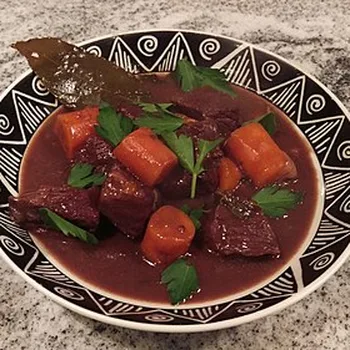
Beef Bourguignon Stew
Beef bourguignon is the king of French meat dishes: cubes of beef slow-cooked for hours with carrots, mushrooms and caramelised onions until they melt in the mouth. Its glycemic index does not apply, and it is a luxurious winter meal that boosts iron levels and energy.
Glycemic index
Glycemic load
Calories
Protein
💡 Smart Nutritional Guidance
Consumption advice
Eat your portion with a fork together with the vegetables cooked in the sauce, and replace white mashed potato with creamy cauliflower purée for a meal that is light on blood sugar.
Best preparation methods
The secret of its tenderness is cooking it over very low heat for two and a half hours; a herb-rich beef stock with balsamic vinegar as the alternative gives it an exceptional, authentic flavour.
Important Nutritional Note
A rich source of iron, zinc, vitamin B12 and collagen dissolved from the meat's connective tissue, very good for the joints and against anaemia.
Nutrition facts
| Nutrient | Per 100 g | Per typical portion (250 g) |
|---|---|---|
| Calories | 235 kcal | 587.5 kcal |
| Protein | 25 g | 62.5 g |
| Carbohydrate | 6.5 g | 16.2 g |
| Available carbohydrate | 4.7 g | 11.8 g |
| Fat | 12 g | 30 g |
| Dietary fibre | 1.8 g | 4.5 g |
The typical portion is approximate, for comparison purposes.
Comparison & smarter alternatives
It has 235 kcal per 100 g, ranking 6 of 8 in French dishes (lowest first).
Related foods from the same family:
Frequently asked questions
Does beef bourguignon affect glucose levels?
It has no effect on blood sugar because it is essentially protein; the carrots cooked with it have a very small effect within a complete protein- and fat-rich meal.
How many calories and how much protein are in a 250 g portion of beef bourguignon?
It provides about 590 kcal, 62.5 g of pure protein and around 30 g of fat, with about 16 g of carbohydrate from the vegetables.
Is it suitable for people with high uric acid (gout)?
People with gout should be very moderate and avoid the concentrated sauce, because slow-cooked beef is high in purines.
Reviewed by the WiBo Health medical team · Last reviewed 13 October 2026
Disclaimer: This guidance is for nutritional lifestyle orientation and does not constitute a diagnostic medical device under EU Regulation MDR 2017/745.