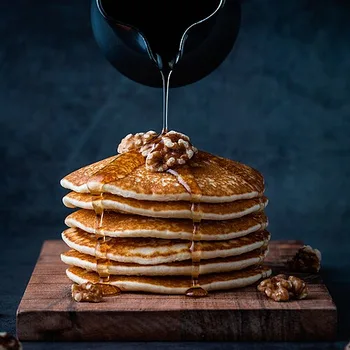
Baghrir Thousand-Hole Semolina Pancakes
Moroccan baghrir ('thousand-hole' pancakes) is the famous North African pancake whose dense holes soak up honey and melted butter; it is made from fine semolina and yeast and cooked on one side only. It has a medium glycemic index (clinically reviewed estimate ≈65) and graces traditional breakfast tables.
Glycemic index
Glycemic load
Calories
Protein
💡 Smart Nutritional Guidance
Consumption advice
Have one medium baghrir with a light brush of olive oil or natural honey, together with a boiled egg and a cup of unsweetened tea.
Best preparation methods
Cook baghrir in a non-stick pan wiped with water between pancakes to get the dense holes without any fat in the cooking.
Important Nutritional Note
Baghrir has no fat in its batter; the risk for people with diabetes comes from how much butter-and-honey syrup it soaks up, so control the fat and sweetener.
Nutrition facts
| Nutrient | Per 100 g | Per typical portion (80 g) |
|---|---|---|
| Calories | 210 kcal | 168 kcal |
| Protein | 5.8 g | 4.6 g |
| Carbohydrate | 42 g | 33.6 g |
| Available carbohydrate | 39.8 g | 31.8 g |
| Fat | 2.1 g | 1.7 g |
| Dietary fibre | 2.2 g | 1.8 g |
The typical portion is approximate, for comparison purposes.
Comparison & smarter alternatives
Among the foods in Sweets & desserts with a glycemic index (27), it ranks 16 (lowest first).
Smart alternatives from the same family:
Frequently asked questions
Is baghrir allowed for people with diabetes?
Yes, one small palm-sized pancake (80 g), brushed with a teaspoon of natural honey or olive oil rather than drenched in syrup.
How many calories are in a typical plain baghrir (80 g)?
A plain pancake contains about 170 kcal, 4.5 g of protein, less than 2 g of fat and 34 g of light starch.
What creates the dense holes in baghrir?
A double rise with yeast and baking powder, and cooking on one side over medium heat, make the air bubbles burst upward and leave the famous holes.
Reviewed by the WiBo Health medical team · Last reviewed 13 October 2026
Disclaimer: This guidance is for nutritional lifestyle orientation and does not constitute a diagnostic medical device under EU Regulation MDR 2017/745.