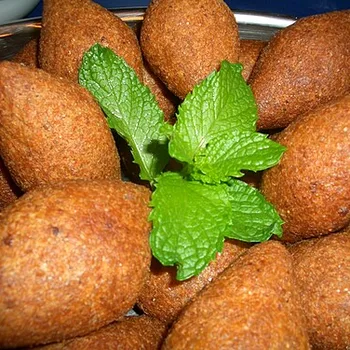
Aleppian Grilled Skewer Kibbeh
Aleppo skewer kibbeh, grilled over charcoal, is a masterpiece of Aleppan cooking: a remarkable blend of lean beef and lamb with fine bulgur, walnuts and Aleppo spices, shaped on skewers and grilled over charcoal. It has a low glycemic index (clinically reviewed estimate ≈42), with an irresistible smoky grilled flavour.
Glycemic index
Glycemic load
Calories
Protein
💡 Smart Nutritional Guidance
Consumption advice
Eat the grilled skewer with a plate of bawaz salad (parsley, onion and sumac), a squeeze of lemon and grilled vegetables such as onion and tomato.
Best preparation methods
Skewer kibbeh uses a meat-to-bulgur ratio of 3 to 1, which keeps it firm on the skewer and very rich in protein.
Important Nutritional Note
Charcoal grilling removes excess fat while keeping the iron and zinc, plus the heart-friendly fat of the walnuts (plant omega-3).
Nutrition facts
| Nutrient | Per 100 g | Per typical portion (150 g) |
|---|---|---|
| Calories | 295 kcal | 442.5 kcal |
| Protein | 18 g | 27 g |
| Carbohydrate | 16 g | 24 g |
| Available carbohydrate | 13.8 g | 20.7 g |
| Fat | 18 g | 27 g |
| Dietary fibre | 2.2 g | 3.3 g |
The typical portion is approximate, for comparison purposes.
Comparison & smarter alternatives
Among the foods in Arabic dishes with a glycemic index (37), it ranks 20 (lowest first).
Smart alternatives from the same family:
Frequently asked questions
Is Aleppo skewer kibbeh suitable for people with insulin resistance?
Yes, an excellent choice: its glycemic index is low (≈42) and it contains very little bulgur compared with its protein and healthy fat.
What is the nutritional value of a typical grilled kibbeh skewer (150 g)?
A skewer contains about 440 kcal, 27 g of protein, 27 g of fat and 24 g of slowly absorbed carbohydrate.
Does skewer kibbeh contain hydrogenated fat?
Never. Its fat is natural, from traditional lamb tail fat and walnuts, and no processed vegetable oils are used.
Reviewed by the WiBo Health medical team · Last reviewed 13 October 2026
Disclaimer: This guidance is for nutritional lifestyle orientation and does not constitute a diagnostic medical device under EU Regulation MDR 2017/745.