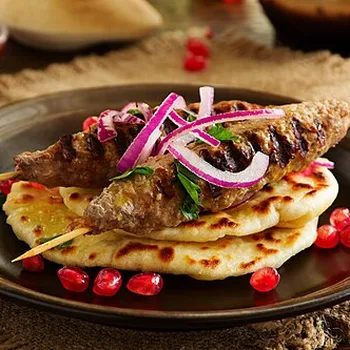
Spicy Adana Minced Meat Kebab
Adana kebab is the king of spicy grills in southern Turkey: hand-minced meat shaped on a wide skewer, seasoned with hot red pepper and tail fat and grilled over blazing charcoal. Its glycemic index does not apply because it contains no carbohydrate, and it is a fiery feast that wakes up the senses and the metabolism.
Glycemic index
Glycemic load
Calories
Protein
💡 Smart Nutritional Guidance
Consumption advice
Eat the grilled skewer with a fork alongside grilled green peppers and tomatoes and a parsley-sumac salad, and skip the white lavash wraps.
Best preparation methods
Kneading the meat only with sweet and hot red pepper and salt, without flour or breadcrumbs, keeps it authentically Turkish and free of starch.
Important Nutritional Note
The capsaicin in hot pepper boosts circulation and energy expenditure, but people with irritable bowel syndrome or reflux should be careful with the heat.
Nutrition facts
| Nutrient | Per 100 g | Per typical portion (150 g) |
|---|---|---|
| Calories | 213 kcal | 319.5 kcal |
| Protein | 17.3 g | 26 g |
| Carbohydrate | 1.3 g | 2 g |
| Available carbohydrate | 1 g | 1.5 g |
| Fat | 16 g | 24 g |
| Dietary fibre | 0.3 g | 0.4 g |
The typical portion is approximate, for comparison purposes.
Comparison & smarter alternatives
It has 213 kcal per 100 g, ranking 10 of 10 in Turkish dishes (lowest first).
Related foods from the same family:
Frequently asked questions
Does Adana kebab raise blood sugar?
It has no effect on blood sugar: it is just protein, fat and red pepper, and its glycemic index does not apply.
How many calories are in a typical Adana kebab skewer (150 g)?
A skewer provides about 320 kcal, 26 g of protein and 24 g of natural fat from the tail fat, with almost no carbohydrate.
What is the difference between Adana and Urfa kebab?
Adana kebab is very hot with red chilli, while Urfa kebab is mild, without chilli, and suits a sensitive stomach.
Reviewed by the WiBo Health medical team · Last reviewed 13 October 2026
Disclaimer: This guidance is for nutritional lifestyle orientation and does not constitute a diagnostic medical device under EU Regulation MDR 2017/745.