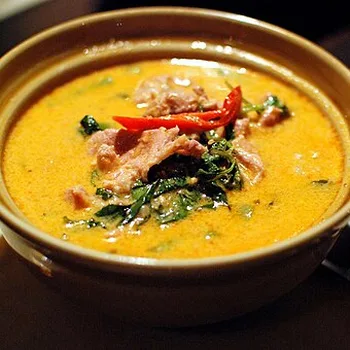
Thai Red Curry with Bamboo Shoots
Thai red curry (gaeng phed) is a warm, deeply flavoured Thai dish: chicken or prawns cooked in coconut milk seasoned with dried red Thai chilli paste, lemongrass, garlic, bamboo shoots and basil. It has a low glycemic index (clinically reviewed estimate ≈35) and offers a luxurious Asian balance of flavours.
Glycemic index
Glycemic load
Calories
Protein
💡 Smart Nutritional Guidance
Consumption advice
Enjoy it with a fork and spoon with the bamboo shoots and meat, and have a green salad alongside to reduce the need for starchy sides.
Best preparation methods
Add bamboo shoots and sweet pepper for more fibre and fullness, and use 100% natural, unsweetened coconut milk.
Important Nutritional Note
The mix of red chilli, coconut milk and galangal supports immunity and vascular flexibility, but the saturated fat of coconut calls for moderation if you are watching total fat.
Nutrition facts
| Nutrient | Per 100 g | Per typical portion (250 g) |
|---|---|---|
| Calories | 124 kcal | 310 kcal |
| Protein | 9.2 g | 23 g |
| Carbohydrate | 3.2 g | 8 g |
| Available carbohydrate | 2.1 g | 5.2 g |
| Fat | 8.4 g | 21 g |
| Dietary fibre | 1.1 g | 2.8 g |
The typical portion is approximate, for comparison purposes.
Comparison & smarter alternatives
Among the foods in Asian dishes with a glycemic index (18), it ranks 6 (lowest first).
Smart alternatives from the same family:
Frequently asked questions
What is the difference between red and green curry?
Red curry is based on dried red chilli and is warmer, deeper and less sharp than green curry, which is made from fresh, pungent green chilli.
What is the nutritional value of a 250 g portion of Thai red curry?
It provides about 310 kcal, 23 g of protein, 21 g of fat (including MCTs) and around 8 g of gently absorbed carbohydrate.
Is red curry safe for people with insulin resistance?
Yes, absolutely: its net carbohydrate is very low and its glycemic index is low (≈35), and it gives lasting energy and fullness.
Reviewed by the WiBo Health medical team · Last reviewed 13 October 2026
Disclaimer: This guidance is for nutritional lifestyle orientation and does not constitute a diagnostic medical device under EU Regulation MDR 2017/745.