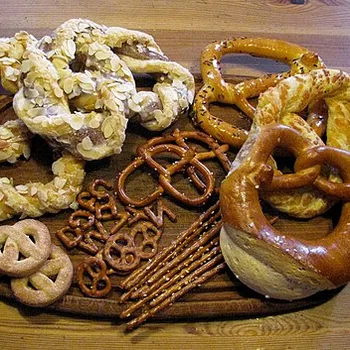
Bavarian Soft Salted Pretzel
The Bavarian pretzel is Germany's famous bake, with its shiny brown crust, coarse salt crystals and iconic knotted shape. It has a high glycemic index (clinically reviewed estimate ≈78) because of its white flour and fast digestion, so people with diabetes need great caution and moderation.
Glycemic index
Glycemic load
Calories
Protein
💡 Smart Nutritional Guidance
Consumption advice
If you want one, divide a large pretzel and eat only a quarter after brushing off most of the salt, together with cottage cheese or a boiled egg to slow the starch absorption.
Best preparation methods
Before baking, the dough is dipped in a special alkaline solution that gives it its distinctive brown colour; for a healthier home version use wholemeal flour and less surface salt.
Important Nutritional Note
A double clinical warning: fast starch that raises blood sugar very quickly (≈78), plus very high surface sodium that can raise blood pressure straight away.
Nutrition facts
| Nutrient | Per 100 g | Per typical portion (90 g) |
|---|---|---|
| Calories | 338 kcal | 304.2 kcal |
| Protein | 8.8 g | 7.9 g |
| Carbohydrate | 69 g | 62.1 g |
| Available carbohydrate | 65.9 g | 59.3 g |
| Fat | 2.8 g | 2.5 g |
| Dietary fibre | 3.1 g | 2.8 g |
The typical portion is approximate, for comparison purposes.
Comparison & smarter alternatives
Among the foods in Breads & pastries with a glycemic index (16), it ranks 16 (lowest first).
Smart alternatives from the same family:
Frequently asked questions
Why is the glycemic index of a pretzel so high?
Because it is made from fine refined white flour baked at high temperatures, which turns it into glucose in the bloodstream almost immediately.
What is the nutritional value of a medium Bavarian pretzel (90 g)?
One pretzel contains about 305 kcal, 8 g of protein, 2.5 g of fat and around 60 g of fast carbohydrate.
How can someone with diabetes eat it safely?
Only a quarter of a pretzel on special occasions, spread with a high-protein cheese, and without eating the coarse salt crystals.
Reviewed by the WiBo Health medical team · Last reviewed 13 October 2026
Disclaimer: This guidance is for nutritional lifestyle orientation and does not constitute a diagnostic medical device under EU Regulation MDR 2017/745.